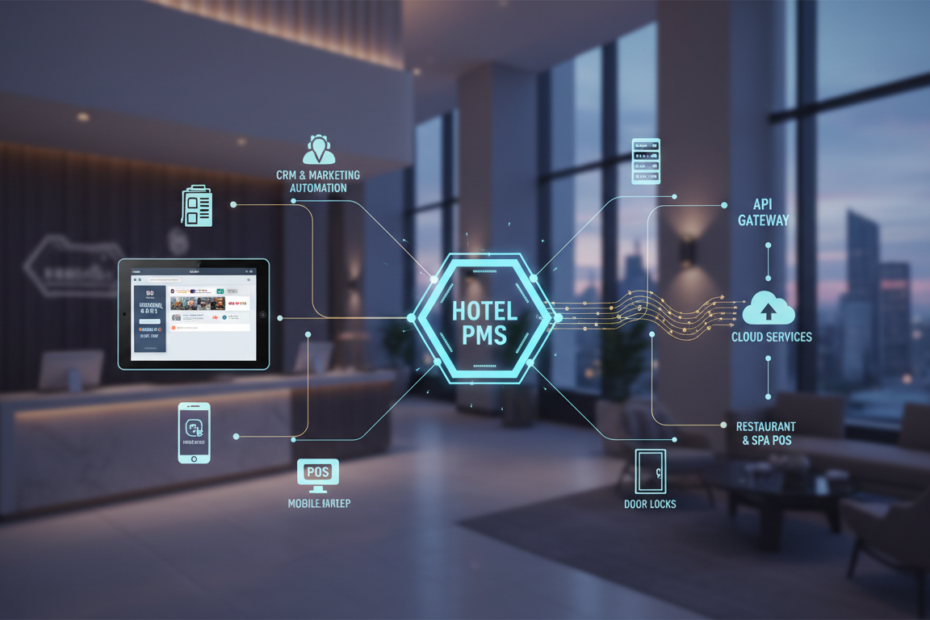
A property management system rarely operates as a standalone tool. It needs to exchange data continuously with a channel manager, a payment gateway, a point of sale system, and often several other pieces of hotel technology. How well a hotel PMS handles those connections — through its API and integration architecture — often matters more to daily operations than any single front-end feature. This guide walks through what hoteliers should understand and ask about before signing with a vendor.
What an API Actually Means for a Hotel
An API, or application programming interface, is essentially the mechanism that allows two software systems to exchange data automatically, without a staff member manually transferring information between them. When a booking comes in through an OTA, the API connection between the channel manager and the PMS updates room availability instantly. When a rate changes in a revenue management tool, the API pushes that update out to every connected distribution channel.
The quality of this connection determines whether data moves in real time or with a delay, and whether it moves reliably or occasionally drops updates. For a hotel managing inventory across a dozen or more OTAs, even small delays or failures in this synchronization can lead directly to overbookings or rate discrepancies that damage guest trust and revenue.
Types of Integrations Hotels Should Evaluate
Channel manager connectivity. This is typically the most business-critical integration, since it governs how rates and inventory sync across every OTA a hotel sells through. Ask specifically whether the channel manager connection is real-time, two-way, and whether it’s a native integration built by the same provider or a third-party bridge that could introduce additional points of failure.
Booking engine integration. For direct bookings through the hotel’s own website, the booking engine needs to pull live availability and rates directly from the PMS, ensuring guests never see outdated pricing or book a room that’s no longer available.
Payment gateway connectivity. Secure, PCI-compliant payment processing integrated directly into the PMS reduces manual reconciliation and lowers the risk of payment data handling errors.
Point of sale integration. For properties with restaurants, bars, or spas, a connected point of sale system allows charges to post directly to a guest’s room folio, avoiding duplicate entry and reducing billing errors at checkout.
Revenue management integration. Whether built-in or connected through API, a revenue management system needs continuous access to occupancy and booking pace data to generate accurate, timely pricing recommendations.
Accounting and back-office systems. For hotels using dedicated accounting software, integration reduces the manual work of transferring financial data between systems at month-end close.
CRM and guest communication tools. Integration here supports automated pre-arrival messaging, post-stay follow-up, and consolidated guest history that informs personalization across future stays.
Questions to Ask Vendors About API Architecture
Before committing to a hotel PMS, it’s worth asking pointed technical questions rather than accepting general assurances that “integration is supported.”
Ask whether the API is open and well-documented, allowing third-party developers or your own IT team to build custom connections if needed, or whether integrations are limited strictly to a pre-approved partner list. An open, well-documented API generally indicates a more mature, flexible platform.
Ask how integration failures are handled. Does the system alert staff automatically when a sync fails, or does the failure go unnoticed until a discrepancy is discovered manually? This distinction matters significantly for preventing overbookings.
Ask about update frequency for each critical integration. Real-time sync is standard for channel management in modern systems, but some older or lower-tier connections still rely on periodic batch updates, which introduce meaningful lag during high-demand periods.
Ask what happens during vendor-side outages or maintenance windows, and whether there’s a fallback process to prevent data loss or missed updates during that time.
Native Integration vs Third-Party Bridges
One of the more important distinctions in evaluating hotel PMS API architecture is whether integrations are native — built and maintained directly by the PMS vendor — or dependent on third-party middleware connecting otherwise separate systems. Native integrations, particularly within an all-in-one hotel management software platform, tend to be more reliable because the same team maintains both sides of the connection and can resolve issues faster when something breaks.
Third-party bridges can work adequately, but they introduce an additional layer that can fail independently of either core system, and troubleshooting often becomes more complicated since responsibility is split between multiple vendors.
Security Considerations for API Connectivity
Any integration handling guest data or payment information needs to meet appropriate security standards. Ask vendors about encryption practices for data in transit, compliance certifications relevant to your market, and how API access credentials are managed and rotated. A hotel PMS with weak integration security creates risk that extends beyond operational inefficiency into genuine data protection liability.
Planning for Future Integration Needs
Technology needs evolve. A hotel that doesn’t currently use a sophisticated revenue management tool or a dedicated CRM might adopt one within a few years. Choosing a PMS with a genuinely open, well-supported API — rather than one that only connects with a narrow, fixed set of partners — protects against having to replace the entire system later simply to add a capability that wasn’t anticipated at the time of purchase.
Making an Informed Technical Decision
Evaluating a hotel PMS purely on its front-end interface misses a critical part of the picture. The strength of its API and integration architecture determines how reliably data flows across your entire technology stack — and by extension, how accurately your rates, inventory, and guest information stay synchronized across every channel and system your hotel depends on. Asking detailed technical questions before signing, rather than after issues surface in daily operations, is one of the most valuable steps a hotelier can take during the buying process.