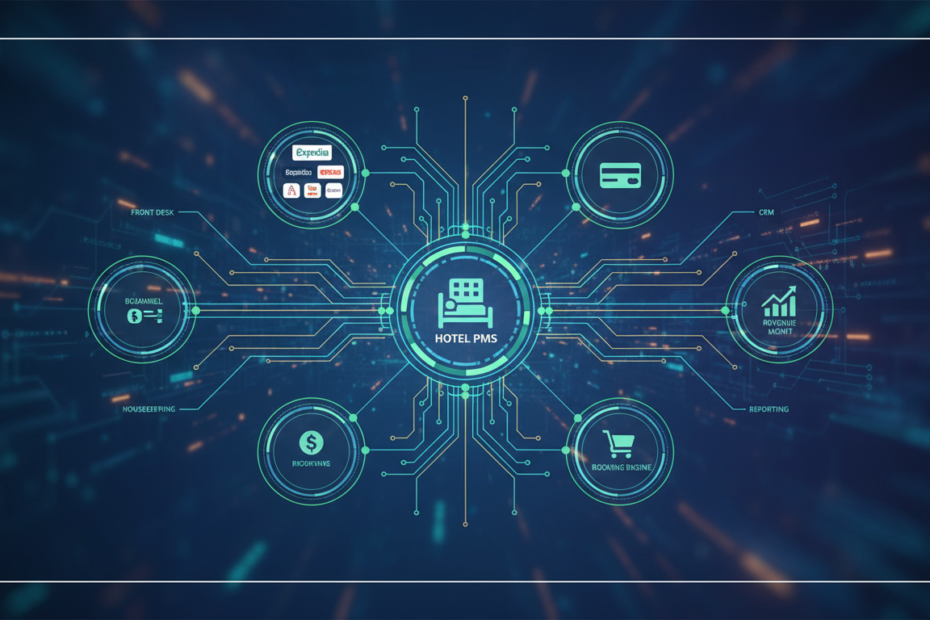
Ask any hotelier who has dealt with a double booking what caused it, and the answer often traces back to the same root problem: the property management system and channel manager weren’t communicating properly. These two systems handle related but distinct jobs — one manages the property’s operations, the other manages distribution across OTAs — and when they aren’t tightly connected, the gap between them becomes a direct source of revenue loss and guest frustration.
This piece looks at why that connection matters so much and what a genuinely integrated setup looks like in practice.
Two Systems, One Shared Responsibility
A property management system governs what happens inside the hotel: reservations, room assignment, guest folios, and daily operations. A channel manager governs how the hotel’s rooms and rates appear across external booking platforms — Booking.com, Expedia, Agoda, and dozens of others, depending on the property’s distribution strategy.
These two systems need to agree, constantly and instantly, on two things: how many rooms are available, and at what rate. When a room books through an OTA, that inventory needs to disappear from every other channel immediately, and the front desk needs to see the reservation appear in the PMS without anyone manually entering it. When a rate changes, whether from a revenue management decision or a manual adjustment, it needs to update everywhere at once.
What Happens When the Connection Is Weak
Hotels running a disconnected or loosely connected channel manager and PMS setup tend to run into a predictable set of problems. Overbookings occur when two channels sell the same room because inventory updates lagged or failed to sync. Rate parity issues arise when a manual change on one platform doesn’t propagate to others, creating pricing inconsistencies that OTAs may flag or penalize in search rankings. Staff spend meaningful time each day manually cross-checking availability across platforms, time that could otherwise go toward guest service.
These aren’t rare edge cases — they’re common outcomes of running distribution and property management as separate, poorly connected systems, particularly for properties relying on many OTA channels simultaneously.
What a True Integration Looks Like
A properly integrated PMS and channel manager setup operates on real-time, two-way synchronization. A booking made on any connected OTA reflects instantly in the PMS reservation calendar. A rate change made in the PMS, or through a connected revenue management system, pushes out to every OTA simultaneously. Restrictions — minimum length of stay, closed-to-arrival dates, or stop-sell instructions during full occupancy — apply consistently across every channel without requiring manual updates on each individual platform.
This level of integration works best when the channel manager and PMS are built by the same provider, on shared architecture, rather than connected through a third-party bridge that introduces additional points of potential failure. Native integration means updates happen instantly, and troubleshooting issues doesn’t require coordinating between multiple support teams from different companies.
Benefits Beyond Preventing Overbookings
While overbooking prevention is the most immediate benefit, a well-integrated PMS and channel manager stack delivers broader operational advantages. Front desk staff gain a single, reliable source of truth for occupancy and rates, reducing the guesswork and manual reconciliation that eats into productive time. Management gains an accurate, real-time view of performance across every distribution channel from one dashboard, rather than logging into separate extranets for each OTA.
Distribution strategy also becomes more agile. Adjusting rates in response to a sudden demand shift — a local event, a competitor sellout, a booking pace slowdown — can happen once, in one system, and take effect everywhere immediately. This responsiveness matters increasingly as demand patterns shift faster than manual rate management can keep pace with.
Connecting the Direct Channel Too
An integrated operations stack shouldn’t stop at OTA channels. The hotel’s own booking engine and website should draw from the same live inventory and rate data as every other channel, ensuring direct bookings — typically the most profitable channel, since they carry no OTA commission — never show outdated availability or pricing. When the booking engine, channel manager, and PMS all share the same underlying data, the entire distribution strategy operates from one consistent source rather than several loosely coordinated ones.
Evaluating Your Current Setup
For hotels currently running separate PMS and channel manager vendors, it’s worth auditing how well that connection actually performs. Ask how often sync delays or failures occur, and how quickly staff typically notice and correct them. Ask whether restriction changes — like closing a room type to new bookings — apply instantly across all channels or require manual updates per platform. If the answers reveal frequent manual intervention, that’s a signal the current integration isn’t performing as reliably as it should.
Hotels evaluating a new system altogether should treat this integration as a primary selection criterion, not an afterthought. A property management system with a genuinely native, real-time channel manager connection reduces operational risk meaningfully compared to a setup where the two systems were never designed to work together closely.
Building Toward a Fully Connected Stack
The most efficient hotel operations tend to run on a technology stack where the PMS, channel manager, revenue management, and booking engine all share data natively rather than passing it back and forth through separate integrations prone to delay or failure. This kind of connected setup, often available through an all-in-one hotel management software platform, removes much of the manual reconciliation work that consumes staff time and reduces the risk of the overbookings and rate discrepancies that damage both revenue and guest trust.
For any property serious about distribution performance, the relationship between PMS and channel manager deserves close scrutiny — not as two separate purchasing decisions, but as one connected operational foundation.