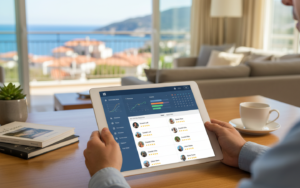
Search for “property management software” and half of what comes back is about tenants, leases and monthly rent collection. That’s a different world. Short-term rental property management software is built for stays measured in nights, not years: guests who come and go every few days, calendars spread across several booking platforms, cleaners who need to know exactly when to arrive, and rules that change by season. It’s closer to hotel software than to landlord software, just scaled down to houses, apartments and cottages. This piece explains what the software is, what it replaces, how it differs from the hotel version, the concepts you’ll run into when you start, and the questions worth asking before you pay for anything. It’s written for people who are still working out whether they need it, so there’s no sales push and no jargon you can’t look up in a minute.
What it is, and what it replaces
In plain terms, it’s the one place where all your reservations, guests, rates and property details live. Before software, most operators use some mix of a spreadsheet, a shared calendar, a notes app and a long WhatsApp thread with the cleaner. That works until volume grows, and then small gaps start to cost real money: a booking written in the wrong cell, a cleaner told the wrong date, a deposit nobody recorded. Property management software replaces that patchwork with a single record. A booking comes in, the calendar updates, the guest gets their messages, a cleaning task appears and the payment is logged, without anyone retyping the details. A good property management system also keeps the history, so you can look back and see what a given guest paid, or what a given unit earned last summer, without digging through old emails.
How it differs from hotel software
The core idea is the same, but the details differ in ways that matter. A hotel sells room types, and the guest gets whichever room of that type is free. A rental sells a specific unit, and every unit is different, with its own photos, house rules, beds and rates. Rentals often have minimum nights, longer average stays and cleaning fees added per stay. Check-in is frequently remote, with no front desk, so lock codes and instructions become part of the workflow. And if you manage homes for other people, you need owner statements and payouts, which hotels rarely deal with. Small hotels, guesthouses and rental operators can sometimes run on the same underlying system, since both need reservations, rates, distribution and billing, but check that unit-level features like per-unit rules and cleaning fees are properly supported before you commit to anything. If your work involves several units or other people, check that the system treats each unit as its own thing, with its own calendar, rates and notes, and not as a loose copy of a hotel room.
Concepts you’ll run into
A few terms come up in every demo. A listing is what guests see on a platform. A unit is the physical property. One unit can have several listings on different platforms, and the software has to map them correctly. A rate plan is a set of prices and rules, and you might have one for weekdays, one for weekends and one for long stays. Minimum nights is the shortest stay you’ll accept on a given date. Channel mapping means linking each listing to the right unit and rate plan inside the software. Turnover is the cleaning and resetting between stays. Fees and taxes can be per stay, per night or per guest, and the rules vary by location. Take an hour to learn these and the demos will make a lot more sense. Ask vendors to explain any term they use that you don’t recognise, and notice who does it patiently. Most of these sound harder than they are, and you’ll be using them comfortably within a week or so.
Who needs it, and when
You probably need it when manual admin eats several hours a week, when you’ve had a double booking, when you have more than two or three units, or when other people need access to your bookings. If you have one cottage and a quiet calendar, you might not yet, and that’s a perfectly sensible place to be. A quick test is to sit down with last month and count. How many hours went on copying details between places? How many mistakes or near misses happened? How many messages were basically the same message? If the answers surprise you, that’s your signal. Also think about the next twelve months, not just today. If you plan to add units, hire a cleaner or take on homes for other owners, it’s cheaper to set up proper software before the mess builds up than to untangle it afterwards, when data lives in five different places.
Questions to ask before you pay
Keep the list short and specific. How do you connect to each booking platform, and how quickly do changes show up? Can I see what the cleaner’s screen looks like? How are owner statements produced, if I need them? What will I pay at my unit count, in total, and what happens to the price when I add one? Can I export all my data if I leave? How fast does support respond on a weekend? Can I try it with my own listings instead of a demo account? Write the answers down, because it’s surprisingly easy to forget what each vendor said by the third demo. If an answer is vague, ask again, politely, and note whether the second answer is clearer. A vendor who explains things well before you’ve paid usually keeps doing it afterwards.
The best software disappears into the background. It keeps your calendar right, tells people what they need to know and lets you focus on the homes and the guests. Aiosell offers a property management system, channel manager and booking engine that work together, so small operators can run reservations, distribution and direct bookings from one set of data instead of juggling separate tools. If you’re still deciding whether you need any of this, do the month-count exercise first. It tends to answer the question honestly.