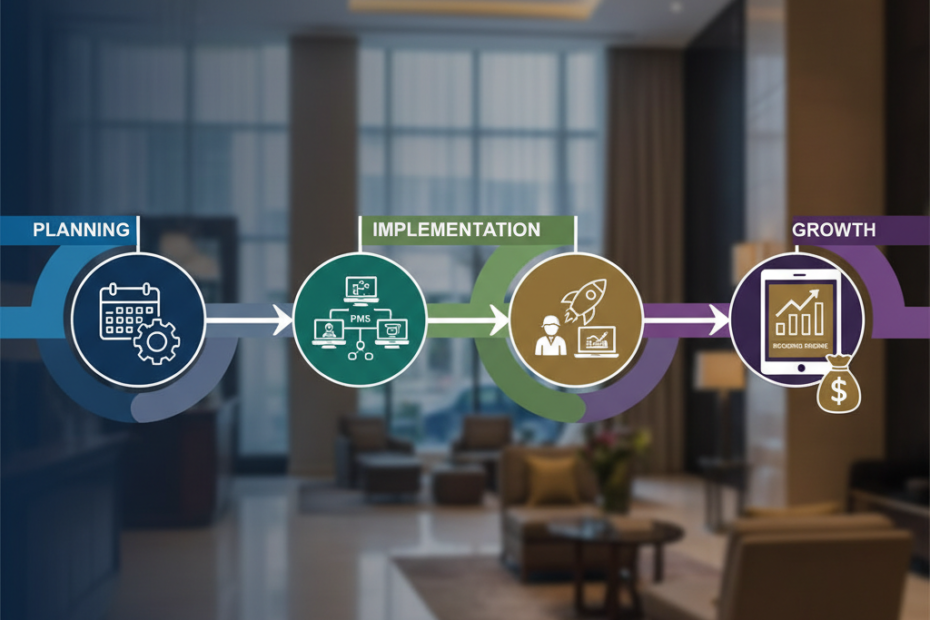
A property management system (PMS) and a booking engine work best when they function as a single connected system. Together, they simplify reservations, reduce manual work, and help hotels increase direct bookings while maintaining accurate room availability and guest information.
Hotels that rely on disconnected systems often face duplicate entries, booking errors, and unnecessary operational delays. Integrating the PMS with the booking engine eliminates these issues by allowing reservation data, inventory, rates, and guest details to update automatically across systems.
Why PMS and Booking Engine Integration Matters
Direct bookings are among the most profitable sources of revenue for hotels. Unlike OTA bookings, reservations made through your website do not incur commission fees, giving you greater control over pricing and guest relationships.
When a booking engine is integrated with the PMS, every reservation updates room inventory and availability in real time. This minimizes the risk of overbookings, prevents manual errors, and allows hotel staff to focus on guest service instead of administrative tasks.
The integration also creates a smoother booking experience. Guests can view accurate availability, receive instant confirmations, and complete reservations without delays. For hotels, this means improved operational efficiency and better opportunities to convert first-time guests into repeat customers.
Phase 1: Planning and Vendor Selection
A successful implementation starts with careful planning. Involve key departments such as front office, housekeeping, reservations, revenue management, finance, and IT to understand operational requirements and identify existing challenges.
Create a clear list of business needs before evaluating PMS providers. During product demonstrations, assess how the system supports your daily operations rather than focusing only on features. Review the user interface, reporting capabilities, integrations, and data migration process.
Discuss implementation timelines, customer support, software updates, scalability, and pricing. Understanding ongoing costs, support availability, and future expansion options helps avoid unexpected expenses after deployment.
Before signing the agreement, ensure that all promised features, service levels, implementation timelines, and support commitments are documented. A detailed contract establishes clear expectations for both parties and reduces implementation risks.
Phase 2: Configuration and Data Migration
After selecting a solution, implementation moves to system configuration and data migration. This stage determines how effectively the PMS supports your hotel’s daily operations.
Room categories, rate plans, packages, taxes, policies, and user permissions must be configured correctly. At the same time, historical guest data, reservations, and operational records are transferred from the existing system.
Not every piece of legacy data needs to be migrated. Removing duplicate records, outdated guest information, and obsolete rate plans improves data quality and simplifies future operations. A clean database also reduces implementation complexity and improves reporting accuracy.
This phase also includes integrating essential hotel systems such as the booking engine, channel manager, payment gateway, POS, and other operational tools. Testing these connections before launch ensures that reservations, payments, and inventory updates flow seamlessly between systems.
Phase 3: Staff Training and System Testing
Technology delivers value only when employees know how to use it effectively. Comprehensive training prepares staff for a smooth transition and reduces operational disruptions after launch.
Training should be role-specific. Front desk teams require reservation and check-in workflows, housekeeping focuses on room status management, while revenue and reservations teams need expertise in pricing, availability, and reporting.
Practical exercises using real booking scenarios help employees gain confidence before the system goes live. Common situations such as reservation modifications, cancellations, payment processing, and room changes should be part of every training session.
Testing should run alongside training. Most PMS providers offer a test environment where hotel teams can simulate reservations, verify payment processing, review reports, and validate integrations. Identifying issues during testing is far less disruptive than resolving them after launch.
Phase 4: Go-Live and Continuous Optimization
Go-live marks the transition from preparation to daily operations. Selecting the right launch period can significantly reduce operational risk. Many hotels schedule implementation during lower occupancy periods to allow staff time to adapt without affecting guest experience.
During the first few days, implementation specialists should remain available to resolve configuration issues, answer questions, and support hotel teams. Quick responses during this period help minimize disruptions and build user confidence.
Implementation does not end once the system is live. Hotels should continuously review operational workflows, booking performance, and guest feedback to identify opportunities for improvement. Regular software updates, staff training, and system reviews help maximize long-term value from the PMS and booking engine.
Common Challenges to Avoid
Many implementation issues result from inadequate planning rather than software limitations.
One of the most common mistakes is insufficient staff training. Employees who are unfamiliar with new workflows often revert to manual processes, reducing the benefits of automation. Providing continuous support after launch encourages faster adoption.
Poor communication during migration can also affect guest experience. If maintenance or temporary booking interruptions are expected, notify guests in advance through email and your website. Clear communication helps maintain trust and reduces confusion during the transition.
Another challenge is migrating outdated or inaccurate data. Reviewing and cleaning legacy records before migration improves system performance and reporting accuracy from day one.
Measuring Implementation Success
The success of a PMS implementation extends beyond completing the installation. Hotels should monitor operational and commercial performance after deployment.
Key performance indicators include an increase in direct bookings, reduced booking errors, faster reservation processing, improved occupancy management, and higher staff productivity. Hotels should also evaluate how effectively the booking engine synchronizes rates, inventory, and availability across all sales channels.
A fully integrated PMS and booking engine provide real-time visibility into reservations, pricing, and guest information while supporting consistent rate parity across direct and third-party channels.
Final Thoughts
A PMS and booking engine form the foundation of modern hotel operations. When implemented with careful planning, accurate data migration, comprehensive staff training, and ongoing optimization, they help hotels streamline operations, improve guest experiences, and increase direct revenue.
The implementation process requires time and coordination, but the long-term benefits extend well beyond operational efficiency. With the right technology partner and a structured rollout plan, hotels can build a scalable digital foundation that supports sustainable growth and stronger direct booking performance.