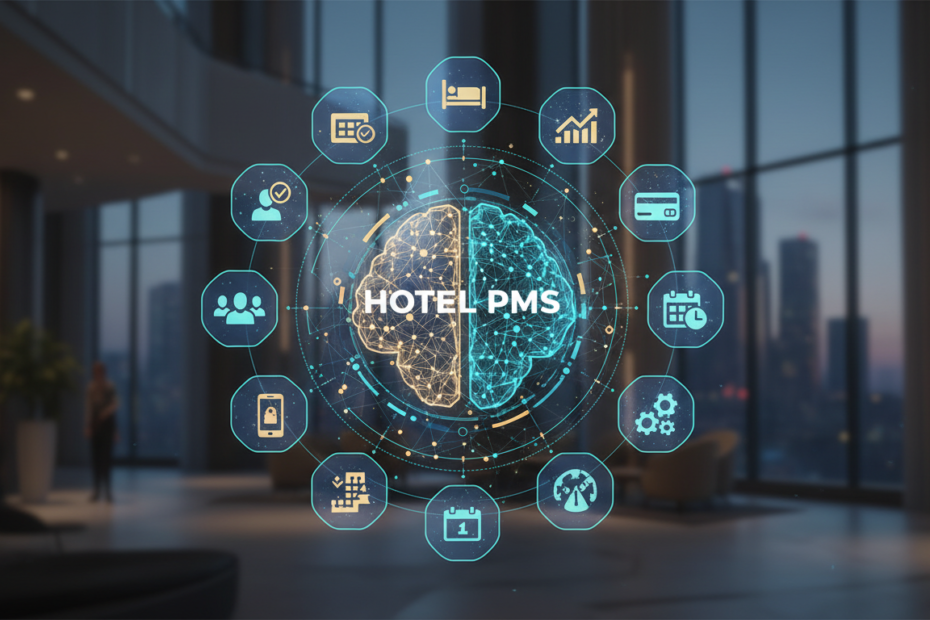
Reviewing a hotel PMS feature list can feel overwhelming, particularly when vendors bundle dozens of capabilities without explaining which ones actually affect day-to-day operations. Some features are essential for every property, while others matter only for specific segments — a resort managing spa bookings, for instance, has different needs than a limited-service hotel focused purely on rooms. This breakdown organizes the capabilities that matter most by operational area, so hoteliers can evaluate a system against what their property genuinely requires.
Front Desk and Reservations
The reservations engine is where staff spend the most time, so usability here carries outsized weight. Key capabilities include a real-time availability calendar, flexible rate plan configuration, group booking and rooming list management, waitlist handling, walk-in booking support, split and shared reservation handling, deposit and cancellation policy automation, and quick search across guest records. A well-designed property management system also supports multiple room types and rate categories without requiring workarounds.
Check-In and Check-Out
Speed and accuracy matter most here, since this is where guests interact directly with hotel operations. Look for digital registration card capture, ID scanning integration, automated key card encoding, express check-out options, folio review before departure, group check-in batch processing, and early check-in or late check-out flagging tied to housekeeping status.
Housekeeping and Maintenance Coordination
Room status accuracy directly affects sellable inventory. Relevant capabilities include real-time room status updates (clean, dirty, inspected, out of order), housekeeping task assignment by staff member, maintenance request logging and tracking, mobile access for housekeeping teams, automated status sync between front desk and housekeeping, and reporting on room turnaround times.
Billing, Folio, and Payments
Financial accuracy reduces both guest disputes and back-office reconciliation. Important features include split billing across multiple guests or companies, multi-currency support for international properties, automated tax calculation by jurisdiction, integrated payment gateway processing, deposit and advance payment tracking, folio export in multiple formats, and night audit automation.
Distribution and Channel Connectivity
This is where a hotel PMS extends beyond the property itself. Core capabilities include real-time two-way sync with a channel manager, rate parity monitoring across OTAs, automated inventory allocation by channel, restriction management (minimum stay, closed to arrival, and similar rules), and connection to a direct booking engine and website to reduce OTA commission dependency.
Revenue Management and Pricing
Static pricing leaves revenue on the table in a market where demand shifts constantly. Capabilities worth evaluating include AI-based dynamic pricing recommendations, competitor rate tracking, demand forecasting based on booking pace, rate strategy rules and guardrails, occupancy-based rate triggers, and length-of-stay pricing optimization.
Guest Profile and CRM
Personalization increasingly drives guest loyalty and repeat bookings. Look for consolidated guest history across stays, preference tracking, automated pre-arrival and post-stay communication, loyalty program integration, guest segmentation for targeted offers, and a connected CRM and leads management system for corporate and group sales pipelines.
Point of Sale Integration
For properties with restaurants, bars, or spas, seamless POS connectivity avoids duplicate data entry. Relevant capabilities include charge posting directly to guest folios, inventory tracking across outlets, multi-outlet reporting, and a connected point of sale system that shares data natively with the PMS rather than operating as a separate application.
Reporting and Analytics
Management decisions depend on accurate, accessible data. Core reporting capabilities include occupancy and ADR dashboards, RevPAR and GOPPAR tracking, departmental performance breakdowns, forecast versus actual comparisons, source-of-business analysis, and exportable reports for ownership or investor updates.
Multi-Property and Group Management
For chains and groups, centralized control avoids treating each property as an isolated system. Important capabilities include single-login access across properties, consolidated group-level reporting, centralized rate strategy configuration, cross-property guest recognition, and role-based access control by property or department.
Operational and Back-Office Extensions
Many modern platforms extend beyond core PMS functions into broader hotel ERP territory. Useful capabilities include purchase and inventory management, accounting and expense tracking, HR and staff scheduling, banquet and event space management, and review and reputation monitoring — all valuable when integrated directly with the PMS rather than managed through separate, disconnected software.
Mobile and Remote Access
Staff increasingly need to work away from a fixed terminal. Relevant capabilities include mobile check-in and check-out, tablet-based housekeeping updates, remote dashboard access for management, and push notifications for critical events like overbookings or maintenance issues.
Security and Compliance
Often overlooked until something goes wrong, these features protect both the property and its guests. Look for role-based user permissions, audit logs for data access, encrypted payment processing, automatic security updates, and compliance support for regional data protection requirements.
Prioritizing What Actually Matters
Fifty capabilities sound comprehensive, but not every property needs all of them equally. A boutique hotel with no restaurant doesn’t need deep POS integration. A single-property independent hotel doesn’t need multi-property consolidation tools, at least not yet. The more useful exercise is mapping this list against your specific operation, ranking which capabilities solve real, current friction points versus which ones sound appealing but wouldn’t change daily operations meaningfully.
The strongest hotel PMS platforms don’t just check every box — they execute the boxes that matter to your property with genuine depth, and connect cleanly with the surrounding systems, from channel managers to revenue tools, so none of these capabilities operate in isolation. When evaluating vendors, ask to see the specific features relevant to your property type in action, rather than relying on a feature list alone to make the decision.