A guest reports small insects near the bed shortly after checking in. The front desk receives the complaint, housekeeping needs instructions, and management must decide how to handle the room. Without a clear process, different employees might take different actions. This creates confusion and increases the risk of further guest complaints.
For US hotels, a documented bed-bug response workflow for lodging operators helps teams manage reports consistently. A written procedure defines who receives complaints, how staff protect affected rooms, when pest-control professionals inspect the property, and how management records the outcome.
A consistent process also supports guest communication, staff accountability and operational continuity.
Why Hotels Need a Documented Bed-Bug Response Process
Bed bugs create operational challenges beyond the affected guest room. A reported case often involves front-desk employees, housekeeping supervisors, maintenance teams, management and external pest-control professionals.
Without written instructions, employees might move luggage or bedding before receiving guidance. Staff might also return a room to service before a professional inspection confirms the next steps.
A documented bed-bug response workflow for lodging operators gives every department a clear role. The procedure should cover:
Receiving and recording guest complaints.
Notifying the appropriate manager.
Limiting access to the reported room.
Contacting a qualified pest-control professional.
Coordinating inspections of relevant areas.
Recording treatment and follow-up actions.
Confirming room-release approval.
The objective is to establish a repeatable response rather than rely on individual judgement during a stressful situation.
Step 1: Record the Initial Guest Report
The front desk often receives the first report. Employees should listen carefully, remain professional and avoid dismissing the guest’s concern.
Staff should record the information without making a diagnosis. A guest’s description or photograph does not confirm an infestation.
The initial report should include:
Date and time of the complaint.
Guest room number.
Guest’s description of the concern.
Location where the guest noticed the suspected insects.
Photographs or other evidence voluntarily provided.
Immediate actions taken by the employee.
Manager or supervisor notified.
Employees should avoid promising a specific treatment outcome or making claims before an inspection.
The front desk should also explain the next steps in clear language. Management should handle decisions about room changes, refunds or other guest arrangements according to the hotel’s policies.
Step 2: Restrict Access to the Reported Room
Once management receives a report, the hotel should follow its established room-isolation procedure.
The room should remain unavailable for new guest assignments until the appropriate inspection and clearance process is complete. Employees should not move bedding, furniture or suspected materials between rooms without professional instructions.
Housekeeping staff should receive clear guidance about the affected room. The supervisor should communicate the room status to the front desk and relevant departments.
The room record should include:
Current room status.
Date and time access restrictions began.
Employee responsible for the restriction.
Departments notified.
Instructions received from the pest-control professional.
Hotels should also review nearby rooms when the inspection professional recommends further checks. Management should avoid assuming the issue affects only one room.
Step 3: Contact a Qualified Pest-Control Professional
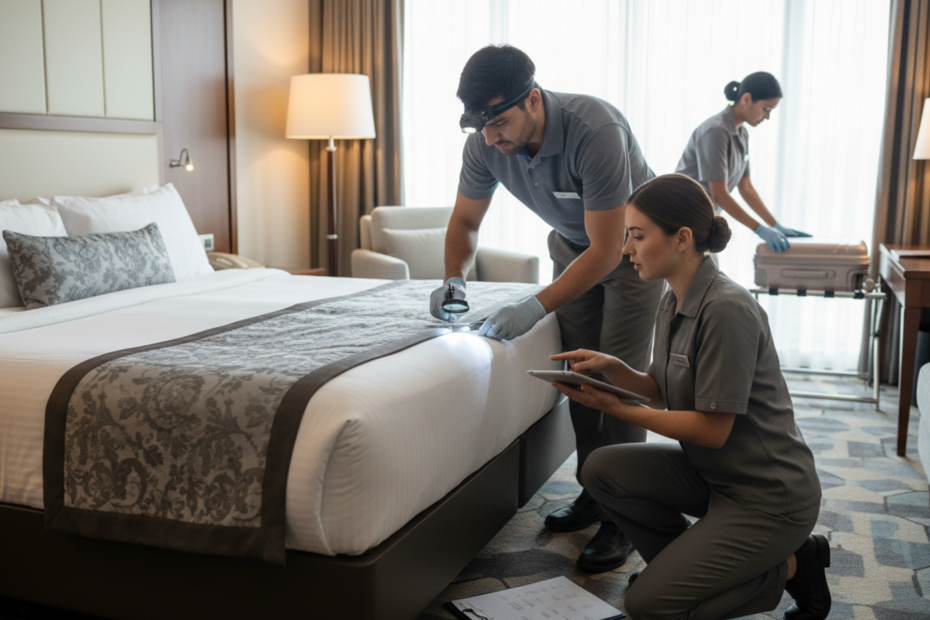
Hotel employees should not attempt to identify the full extent of an infestation through visual checks alone. A qualified pest-control professional should inspect the reported area and recommend appropriate action.
The hotel should maintain contact details for approved pest-control providers. Management should also define an escalation process for urgent reports received outside normal business hours.
During the inspection, the hotel should request written documentation covering:
Inspection date and time.
Areas examined.
Findings and professional assessment.
Recommended treatment or corrective action.
Preparation instructions for hotel employees.
Follow-up inspection requirements.
Conditions for returning the room to service.
Treatment decisions should remain with qualified professionals. Employees should follow the provider’s instructions and applicable product-label requirements. Staff should not apply pesticides or recommend chemical treatments independently.
Step 4: Coordinate Housekeeping and Room Preparation
Housekeeping teams play an important role in room recovery. Their responsibilities should follow the pest-control professional’s instructions.
Managers should communicate approved preparation steps before assigning work. Instructions should explain which items require handling, where materials should go and which cleaning procedures apply.
A documented bed-bug response workflow for lodging operators should define how housekeeping supervisors:
Receive written instructions from the pest-control provider.
Brief the employees assigned to the affected room.
Confirm access restrictions and handling requirements.
Record completed preparation activities.
Report any additional observations to management.
Keep the room unavailable until formal clearance.
Employees should not improvise disposal, laundering or chemical-treatment procedures. The pest-control provider should specify suitable methods for affected materials.
Hotels should also maintain records of staff instructions and completed tasks. These records help management confirm whether employees followed the approved process.
Step 5: Manage Guest Communication and Room Changes
Guest communication requires care and consistency. Employees should acknowledge the concern, explain the response process and provide practical assistance.
The front desk should coordinate room changes according to availability and hotel policy. Staff should avoid assigning another room without checking the hotel’s internal room-status records.
Managers should establish standard communication guidelines covering:
Acknowledging the complaint without blaming the guest.
Explaining the inspection process.
Providing updates when new information becomes available.
Recording room changes and related arrangements.
Escalating requests involving refunds or compensation.
Protecting guest privacy when sharing incident details internally.
Employees should share only the information required to manage the report. Guest details and incident records should remain accessible to authorised personnel.
Step 6: Document Treatment and Follow-Up Inspections
A single inspection or treatment visit does not automatically establish room clearance. The hotel should follow the professional’s recommended inspection and follow-up schedule.
Management should maintain a central incident record containing the inspection report, treatment details, staff instructions and follow-up findings.
The record should include:
Pest-control provider’s name and contact details.
Inspection and treatment dates.
Areas inspected or treated.
Professional recommendations.
Follow-up appointment dates.
Outstanding actions.
Written clearance or room-release recommendation.
Hotels should also document any additional findings from nearby rooms when professionals recommend wider inspections.
The manager responsible for the incident should review outstanding actions before approving the next operational step.
Step 7: Approve the Room Before Returning It to Service
Room availability should depend on documented professional guidance and the hotel’s internal approval process.
Housekeeping completion alone should not determine whether a reported room returns to service. Management should verify the required inspection, treatment and follow-up steps before changing the room status.
A room-release checklist should confirm:
Required professional inspections are complete.
Recommended treatment has been carried out.
Follow-up requirements have been addressed.
Supporting reports are recorded.
Housekeeping preparation and cleaning tasks are complete.
The authorised manager has approved the room status update.
The front desk should receive confirmation before accepting a new reservation for the room.
Bed-Bug Response Workflow Checklist for Hotel Managers
Hotel managers should review the following checklist when creating internal procedures:
Response stage | Required action |
Guest report | Record the complaint and notify management |
Room control | Restrict access and update room status |
Professional inspection | Contact an approved pest-control provider |
Department coordination | Share approved instructions with relevant teams |
Guest support | Record communication and room arrangements |
Treatment records | Store professional reports and follow-up details |
Room release | Obtain approval before returning the room to service |
Management should review the procedure periodically. Staff training should also cover after-hours reporting, escalation contacts and recordkeeping responsibilities.
How Hotel Technology Supports Response Coordination
A bed-bug incident involves several departments and operational records. Hotels need reliable communication between the front desk, management and housekeeping supervisors.
A suitable hotel management software platform supports connected reservation and front-desk operations. Aiosell provides hotel technology for managing reservations, front-desk activities and revenue operations. Hotels should confirm the available room-status controls and integrations before relying on a platform for pest-control incident tracking.
A hotel property management system also supports access to reservation and room information, subject to the platform’s available features. Managers should maintain a separate incident register or approved maintenance process when dedicated pest-control tracking is unavailable.
Aiosell supports connected hotel operations by helping teams manage core reservation and front-desk activities. Hotels should define clear staff responsibilities alongside their technology systems.
Conclusion
A consistent response protects guest confidence and helps hotel teams manage reported bed-bug concerns with greater control. Management should establish clear reporting procedures, restrict affected rooms, involve qualified pest-control professionals and maintain complete incident records.
A documented bed-bug response workflow for lodging operators also gives employees clear instructions during room recovery. Regular staff training, professional inspections and formal room-release approval help hotels maintain consistent operating standards.
Frequently Asked Questions
What should a hotel do after a guest reports bed bugs?
The hotel should record the complaint, notify management, restrict access to the reported room and contact a qualified pest-control professional. Staff should follow the professional’s instructions and document each action.
Should hotels close a room after a suspected bed-bug report?
Hotels should remove the reported room from availability while management arranges an appropriate professional inspection. The room should return to service only after the required professional guidance and internal approval.
Who should manage a bed-bug complaint in a hotel?
A designated manager should coordinate the response. The front desk records the complaint, housekeeping follows approved preparation instructions, and qualified pest-control professionals handle inspection and treatment recommendations.
How should hotels document a bed-bug incident?
Hotels should record the complaint, room details, inspection reports, treatment recommendations, staff actions, follow-up visits and room-release approval. Authorised employees should have access to relevant records.
How often should hotels review their bed-bug response procedures?
Management should review procedures periodically and after significant incidents. Staff training should cover reporting, room restrictions, professional escalation, guest communication and documentation responsibilities.