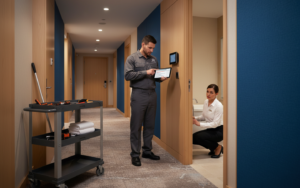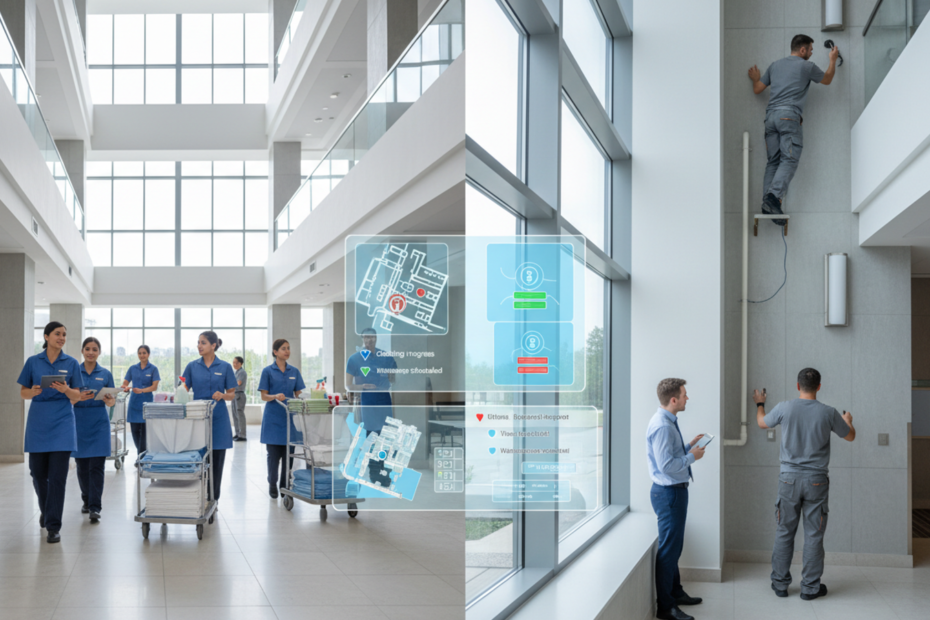
A guest checks out of a room, and housekeeping begins cleaning. During the process, an attendant notices a leaking tap and reports the issue. The room now needs maintenance attention before the next guest arrives. Without clear coordination, the repair might get delayed, the room might be marked ready too early, or housekeeping might need to repeat part of the cleaning.
Coordinating maintenance requests with room cleaning requires a clear process for reporting defects, assigning repairs, updating room status and confirming readiness. Hotel owners and operations leaders should define responsibilities for housekeeping, maintenance and front-desk teams. A consistent process helps reduce delays and protects the guest experience.
Why housekeeping and maintenance coordination matters
Housekeeping teams often identify maintenance problems during room cleaning. These issues range from loose fittings and damaged furniture to plumbing leaks, electrical faults and air-conditioning problems.
When teams work separately, common problems include:
Maintenance requests get lost between shifts.
Attendants report the same issue more than once.
Technicians arrive after housekeeping has completed the room.
Rooms return to inventory before repairs finish.
Cleaning teams repeat work after maintenance activity.
Front-desk staff receive outdated room-status information.
A shared reporting process helps teams understand which rooms need cleaning, repair work, inspection or final release.
Create a clear process for maintenance requests with room cleaning
Hotels should establish a standard workflow for every maintenance issue found during housekeeping. The process should cover reporting, prioritisation, repair, cleaning and room release.
1. Identify and record the issue
Housekeeping attendants should report defects as soon as they notice them. The report should include:
Room number and location.
Description of the defect.
Date and time of reporting.
Name or role of the reporting employee.
Photograph, where useful.
Whether the room requires immediate attention.
For example, an attendant who finds a bathroom leak should record the exact location and visible impact. A clear description helps the maintenance team prepare the right tools and materials.
2. Classify the maintenance request
Not every defect requires the same response time. Supervisors should classify requests based on urgency and their effect on room use.
Priority | Example | Suggested response |
Critical | Exposed electrical wiring, major water leak | Restrict room use and escalate immediately |
High | Air-conditioning failure, blocked toilet | Arrange prompt repair before room release |
Medium | Loose handle, faulty light fitting | Schedule repair based on occupancy |
Low | Minor paint damage, cosmetic wear | Add to planned maintenance work |
The hotel should define response targets for each category. Safety-related defects require immediate attention and should follow the property’s safety procedures.
3. Assign the request to the right person
The housekeeping supervisor should send the report to the maintenance supervisor or designated technician. The assigned person should acknowledge the request and provide an estimated completion time.
Maintain a central maintenance register. Include the room number, issue, priority, assigned technician, status and completion time. A central record reduces dependence on verbal updates.
4. Coordinate repair work with cleaning
Housekeeping and maintenance supervisors should agree on the work sequence.
For example, a technician should complete plumbing repairs before housekeeping performs the final bathroom cleaning. If maintenance work creates dust or debris, the room needs another cleaning round.
The team should avoid sending attendants into rooms while technicians are working unless both supervisors agree on a safe sequence.
5. Inspect and release the room
After repair work, the maintenance team should confirm completion. Housekeeping should then check the affected area and complete any required cleaning.
The room should return to available inventory only after the property’s required checks are complete. Front-desk staff should receive an updated status.
Maintenance requests with room cleaning checklist
Use this checklist to standardise coordination across departments.
Housekeeping staff know how to report maintenance defects.
Every request includes the room number and issue description.
Supervisors assign a priority to each request.
A responsible technician receives the request.
The room status reflects the repair requirement.
Housekeeping and maintenance agree on the work sequence.
Technicians confirm repair completion.
Housekeeping completes follow-up cleaning where required.
A supervisor checks the affected area.
Front-desk staff receive the final room-status update.
Open requests pass to the next shift with clear ownership.
Supervisors should review open requests during shift handovers. This prevents unresolved defects from disappearing between teams.
Best practices for maintenance requests with room cleaning
Hold short coordination briefings
Housekeeping and maintenance supervisors should review expected departures, occupied rooms, pending repairs and priority requests before the main cleaning period.
A short briefing helps both teams plan their workload. During busy periods, repeat the review later in the shift to address new issues.
Use clear room-status categories
Define status labels such as:
Vacant and ready.
Vacant and dirty.
Cleaning in progress.
Maintenance required.
Maintenance in progress.
Cleaning after repair.
Inspected and ready.
Use labels consistently across departments. Avoid vague terms such as “pending” without an explanation.
Set response and completion targets
Agree on response times for different maintenance priorities. Track the time between reporting, technician assignment, repair completion and final room release.
Review delays by cause. A slow repair might result from unavailable spare parts, technician workload or restricted room access.
Plan repairs around occupancy
Use arrival forecasts and expected departures to schedule non-urgent work. Complete planned repairs during periods when room demand is lower.
Do not delay urgent safety or service repairs to protect room availability. Follow the hotel’s safety and room-use procedures.
Keep shift handovers accurate
The outgoing supervisor should record every open request, its current status, assigned person and next action. The incoming supervisor should review the register before accepting responsibility.
Review recurring defects
Track repeated problems by room, equipment type and defect category. Frequent air-conditioning complaints, plumbing leaks or faulty fittings might indicate a need for preventive maintenance.
Managers should review recurring defects with the maintenance team and plan corrective action.
How hotel technology supports coordination
Accurate room information helps housekeeping, maintenance and front-desk teams plan their work. A hotel property management system supports reservation and room-availability workflows. Hotels should check how room-status updates connect with their housekeeping and maintenance procedures.
A hotel front-desk management system also helps reception teams work with current reservation and arrival information. Staff should receive clear updates before promising a room to an arriving guest.
Aiosell provides connected hotel technology for reservations, front-desk operations and revenue workflows. Hotels evaluating hotel management software should check how the platform fits their existing department processes and available integrations.
Do not assume a hotel platform includes a dedicated maintenance ticketing system or repair assignment module. Hotels should maintain a suitable maintenance register or use a dedicated tool for work orders when required. Confirm available integrations before selecting a system.
Aiosell also supports hotel revenue management workflows. Managers should review how occupancy and booking information supports operational planning, while keeping repair tracking and technical responsibilities clearly assigned.
Measure the effectiveness of the process
Managers should track a small set of indicators to understand whether coordination is improving.
KPI | What it measures |
Maintenance response time | Time from reporting to acknowledgement |
Repair completion time | Time taken to close a maintenance request |
Rooms delayed by maintenance | Number of rooms held back due to open defects |
Repeat maintenance requests | Recurring issues in the same room or equipment |
Re-cleaning after repairs | Rooms requiring additional housekeeping work |
Room release time | Time from checkout to final room readiness |
Review these measures weekly. Compare results across similar occupancy periods and room categories. Use the findings to adjust staffing, repair schedules and reporting procedures.
Conclusion
Good coordination between housekeeping and maintenance depends on clear reporting, assigned responsibility and accurate room-status updates. Every request should have an owner, a priority and a recorded outcome.
Hotels should review open requests during shift handovers and track recurring defects. Coordinating maintenance requests with room cleaning becomes easier when departments follow the same process and measure delays consistently.
Aiosell supports connected hotel operations through reservation, front-desk and revenue management technology. Combine suitable hotel systems with a clear maintenance register and defined housekeeping procedures to keep room-readiness decisions accurate.
Frequently asked questions
How should housekeeping report maintenance problems?
Attendants should report the room number, defect description, priority and time of discovery to their supervisor. Photographs help explain visible problems. Supervisors should record each request in a central register.
Who is responsible for coordinating housekeeping and maintenance?
The housekeeping supervisor and maintenance supervisor should coordinate daily work. Each department should retain responsibility for its own tasks, while the operations manager oversees unresolved issues and room-release decisions.
Should housekeeping clean a room before or after maintenance work?
The sequence depends on the repair. When technicians create dust, debris or water residue, complete repairs first and arrange final cleaning afterwards. Supervisors should confirm the sequence for each request.
How should hotels prioritise maintenance requests?
Prioritise issues based on safety, guest impact and room usability. Critical defects require immediate escalation. Minor cosmetic issues should follow a planned maintenance schedule.
How does room-status communication reduce delays?
Clear room-status updates show whether a room needs cleaning, repair, inspection or release. This helps front-desk teams plan arrivals and prevents staff from treating an unfinished room as ready.