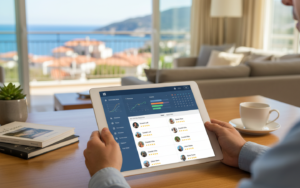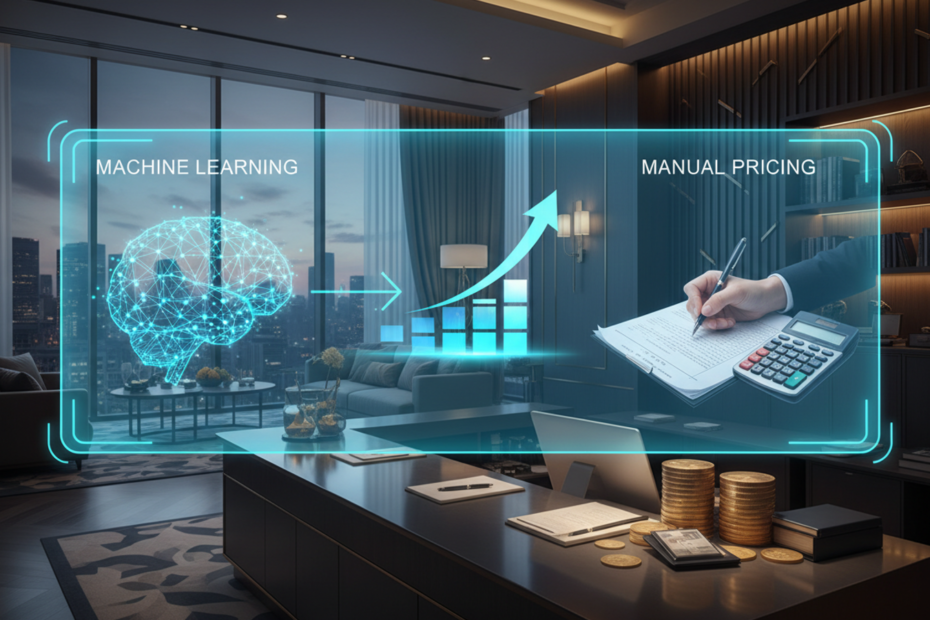
Every pricing tool for hotels seems to say AI now, and it’s hard to tell what that really means. Sometimes it’s a proper forecasting model trained on years of booking data. Sometimes it’s a few rules with a new label. This post tries to cut through that. I’ll explain what AI revenue management does in plain words, where it clearly beats pricing by hand, where it doesn’t, and how to test it without taking anyone’s word for it. I’ll say up front that I think machine learning helps a lot for most hotels, but only when the data going in is decent and a human is still watching. It’s a very fast, very patient assistant. It isn’t a manager, and it doesn’t know that your best corporate client is coming next Thursday unless someone tells it, or the data does.
What AI means here, without the hype
In hotel pricing, machine learning usually means a model that learns patterns from past data. It looks at your history, the day of the week, season, how far ahead guests book, events, cancellations and competitor prices, and it estimates how many rooms you’ll sell at different price points. Then it picks the price that should earn the most. It’s a prediction engine more than anything. Older systems used fixed rules such as raise the price 10% when occupancy passes 70%. Those still work, but they can’t spot patterns you didn’t think to write down. A learning model can notice that a certain weekday behaves differently when a nearby venue has an event. It gets better as more data arrives, as long as the data is clean and your setup is sensible.
Where it beats manual pricing
Volume is the main thing. A hotel with 30 rooms, three room types, four rate plans and six channels has thousands of price decisions across the next year. Nobody can review them all every day, so people focus on the obvious dates and let the rest drift. Software checks everything, every day, and reacts within hours. It also doesn’t get tired, forget to update a channel, or get nervous and drop prices too early. And it’s consistent. Aiosell’s AI dynamic pricing, for example, is described by a long-time client as updating prices several times a day, which is something a small team simply can’t do by hand. Speed matters most when demand changes suddenly, like a flight cancellation wave, a surprise event or a weather alert that moves bookings in one afternoon.
Where manual still wins
People still have the edge in a few places. A new hotel with no history gives a model almost nothing to learn from, so someone has to set sensible starting prices. Local knowledge beats data when it hasn’t shown up in the data yet, like a rumour about a large group, a road closure, or a wedding season that’s about to start. And humans handle relationships. If a regular client asks for a rate for the whole month, that’s a business decision, not a forecast. The best setup is the boring one: the system runs the day-to-day pricing, and a person watches it, sets limits, and overrides it when they know something the model can’t. Hotels that switch the human off completely tend to get surprises, and not the good kind.
Risks to watch
The big risk is bad data. If your room types are a mess, your rate plans overlap or your property management system has wrong bookings in it, the model learns the wrong lessons and confidently produces odd prices. The second risk is the black box. If you can’t see why a price changed, you can’t judge whether it’s right, so ask for the reasons behind each recommendation. Third, don’t ignore guest perception. Prices that bounce around too much can annoy repeat guests and corporate clients, so use floors, ceilings and rules for loyal customers. Finally, keep an eye on channels. A new rate has to reach every site together through your hotel channel manager, or you’ll end up with parity problems that cost you more than the clever pricing earned.
How to test it fairly
Don’t test on the busiest week of the year. Pick a normal month, run the AI on one room type or one property, and compare with a similar group that you price by hand. Look at RevPAR, ADR, occupancy, and net revenue after commission. Keep a log of overrides. Ask the vendor how forecast accuracy is measured, and watch it yourself by comparing forecast with actual for a few weeks. Aiosell puts its AI pricing inside the same platform as its PMS, channel manager, and booking engine, and offers a 15-day free trial, which is enough to see whether the suggestions make sense for your rooms. Treat the vendor’s own numbers as the best case. The only figure that matters is what happens to your hotel’s revenue over a few months, and a fair test is the only way to find that out.