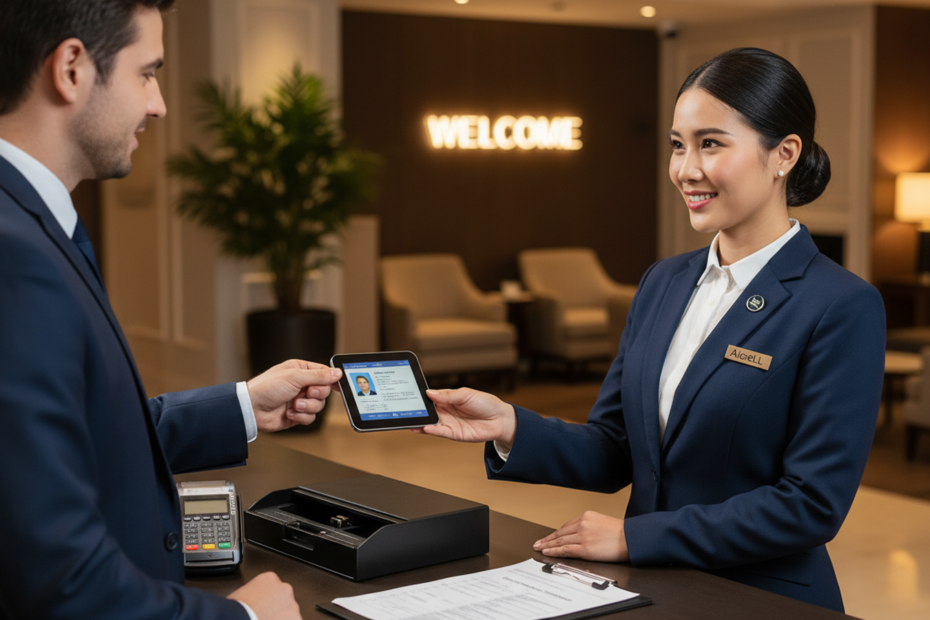
A guest arrives at the front desk and presents a government-issued ID. The employee needs to confirm the reservation details, but the process should not expose more personal information than necessary. Leaving documents visible, sharing ID details across departments or keeping unnecessary copies increases privacy risks.
For US hotels, identity checks form an important part of guest registration and reservation security. A clear process helps employees verify the right person while limiting access to sensitive information.
Creating a guest identity-verification process that limits data exposure requires defined checks, controlled access, staff training and consistent recordkeeping.
Why Hotels Need a Controlled Identity-Verification Process
Hotels collect personal information during reservations and check-in. Depending on the booking and applicable requirements, records might include guest names, contact details, identification information, payment details and stay dates.
Employees need access to certain details to complete their duties. Unrestricted access increases the risk of accidental disclosure, misuse and unauthorised sharing.
Common privacy risks include:
Leaving guest IDs or registration documents visible at the front desk.
Discussing personal information where other guests can hear.
Sharing full identification details through unsecured messages.
Allowing employees to access records unrelated to their duties.
Keeping unnecessary copies of identification documents.
Sending guest information to the wrong recipient.
Leaving printed reports unattended.
A documented procedure gives employees clear boundaries while supporting an efficient check-in experience.
A Checklist for Guest Identity Verification
A practical checklist helps front-desk teams follow the same process across shifts.
1. Confirm the purpose of the identity check
Before requesting identification, establish why the hotel needs to verify the guest.
Common reasons include:
Matching the arriving guest to a reservation.
Confirming the identity of the primary reservation holder.
Following applicable registration requirements.
Reviewing a payment or booking discrepancy.
Applying the hotel’s approved security procedure.
Collect information for a defined business or legal purpose. Avoid requesting additional personal details without a valid reason.
2. Request an appropriate identification document
Follow the hotel’s approved identification policy and applicable state or local requirements.
Depending on the situation, accepted documents might include a driver’s licence, state identification card or passport.
Train employees to check the document’s validity and compare relevant details with the reservation. Do not assume every guest must provide the same document type. Establish a process for guests who lack the usual form of identification.
3. Match only the information required
Employees should compare the details needed to confirm the reservation.
For example, the employee might need to match the guest’s name with the booking record. The employee should avoid reading sensitive identification numbers aloud or copying unrelated details.
A verification checklist should specify which fields employees need to inspect and which details they should avoid recording.
4. Limit document handling and copying
Do not make identification copies as a routine step unless the hotel’s approved policy and applicable requirements support the practice.
If a copy is necessary, define:
The reason for collecting the copy.
Who approves the collection.
Where the copy is stored.
Which employees have access.
How long the record is retained.
How the hotel securely disposes of the record.
Where visual inspection is sufficient, avoid creating another stored copy of the document.
5. Complete verification in a private manner
Keep identification documents away from public view. Position screens so nearby guests cannot easily read personal information.
Employees should avoid discussing identification numbers, addresses or other sensitive details in crowded lobby areas.
Return the document promptly after completing the required check.
6. Record the verification outcome carefully
Follow the hotel’s recordkeeping policy. Record only the information needed to demonstrate completion of the identity check.
For example, an employee might document that the identity check was completed and note the verification date. Avoid adding full identification numbers or unnecessary personal details to general reservation notes.
Best Practices for Limiting Guest Data Exposure
Identity verification requires more than checking a document. Hotels also need controls for handling, storing and sharing guest information.
Apply role-based access
Give employees access to information required for their responsibilities.
Front-desk employees need relevant reservation and check-in details. Other departments should receive only the information required for their work.
Review access permissions when employees change roles or leave the organisation. Remove access promptly when no longer required.
Establish clear retention rules
Keeping personal information indefinitely increases exposure.
Create a retention schedule based on legal obligations, business requirements and the hotel’s privacy policy. Define when identification records, registration documents and related information should be securely deleted.
Do not use a single retention period for every document without reviewing applicable requirements.
Secure printed and digital records
Store paper registration forms in controlled areas. Keep screens locked when employees step away from the desk.
For digital records, use approved systems with access controls. Avoid storing identification images on personal devices, unapproved drives or informal messaging platforms.
Train employees on privacy responsibilities
Staff training should cover:
Approved identification documents.
Information employees need to verify.
Information they should not collect.
Secure document handling.
Guest privacy during conversations.
Reporting suspected data exposure.
Escalating unusual verification requests.
Use practical examples during training. For instance, explain how to handle a guest who asks an employee to send another guest’s identification details.
Create a process for exceptions
Some situations require additional review. Examples include mismatched reservation names, missing identification, suspected identity misuse or requests from someone who is not listed on the booking.
Give employees clear escalation contacts. Staff should avoid making exceptions without approval from an authorised manager.
US Privacy and Data-Protection Considerations
US hotels should review the privacy rules that apply to their locations and business operations.
The California Consumer Privacy Act, as amended by the California Privacy Rights Act, applies to qualifying businesses and provides rights concerning personal information. Other states have their own privacy laws, with different definitions, obligations and exemptions.
Hotels should also review applicable payment-card security requirements when handling payment information. PCI DSS focuses on payment account data, not general identity verification.
A written privacy policy should explain the hotel’s collection, use, retention and sharing practices. Management should review the policy with qualified legal or privacy professionals to confirm compliance with applicable requirements.
Avoid assuming one national procedure covers every state, property type or guest situation.
How Hotel Technology Supports Better Data Handling
Hotels use digital systems to manage reservations, guest details and front-desk operations. A suitable hotel management software platform helps employees access relevant operational information through approved workflows.
Aiosell provides connected hotel technology for reservation management, front-desk operations and revenue management. Hotels evaluating Aiosell should review available access controls, integrations and data-handling practices before using the platform for sensitive guest information.
A hotel property management system should support the hotel’s wider privacy procedures. Managers should verify user permissions, record access, retention settings and security controls before storing identity-related information.
Technology supports organised operations, but hotels still need clear policies, trained employees and regular access reviews.
Conclusion
Guest identity checks help hotels protect reservations and maintain reliable registration procedures. Poor document handling and excessive data collection create unnecessary privacy risks.
Build a consistent process around purpose-based verification, limited information collection, controlled access and secure recordkeeping. Train employees to follow the same standards across every shift.
With suitable systems and clear responsibilities, Aiosell supports organised front-desk operations while hotels maintain their own guest privacy and data-protection controls.
Frequently Asked Questions
1. What is a guest identity-verification process in a hotel?
A guest identity-verification process is a set of steps employees follow to confirm a guest’s identity during reservation checks or check-in. The process should define accepted documents, required checks and recordkeeping responsibilities.
2. How do hotels verify guest identity without collecting excessive personal information?
Hotels should confirm only the details required for the verification purpose. Employees should avoid copying identification documents or recording sensitive numbers unless an approved policy or legal requirement supports collection.
3. Should hotels keep copies of guest identification documents?
Hotels should not make copies automatically. Management should review applicable laws, business requirements and privacy policies before deciding whether document copies are necessary.
4. How should hotels protect guest information at the front desk?
Hotels should limit document visibility, restrict system access, secure printed records, use approved digital systems and train employees on privacy procedures.
5. What should hotel staff do when a guest’s identification does not match the reservation?
Employees should pause the verification process and follow the hotel’s escalation procedure. An authorised manager should review the discrepancy before staff approve changes or disclose reservation information.