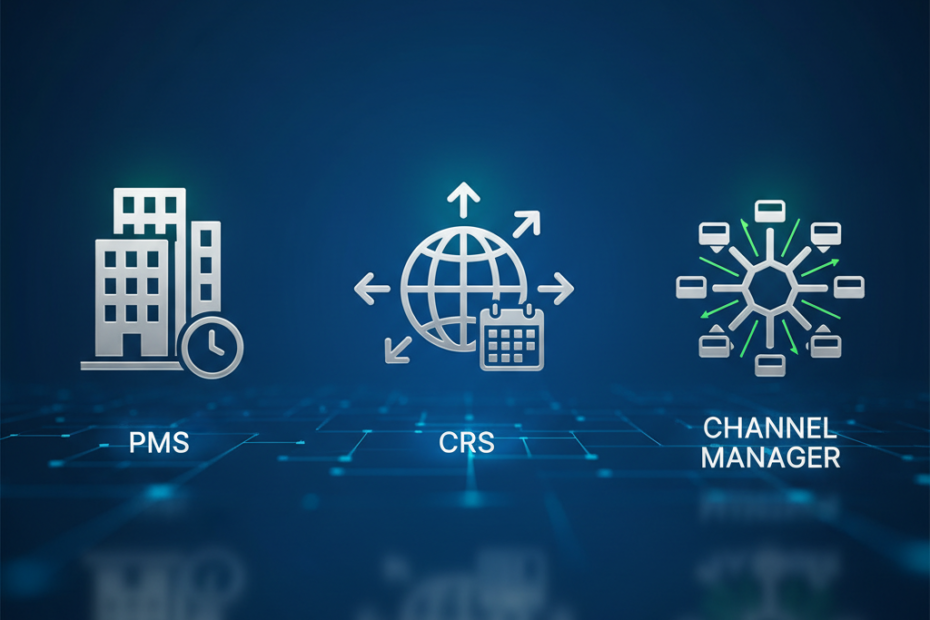
Ever wonder how hotels keep track of room bookings, guest check-ins, housekeeping schedules, and online reservations from countless websites? The answer is simple: three software systems all talking to each other. A hotel PMS, CRS, and channel manager are the backbone of how a modern property gets rooms booked and guests in beds. Sound like a lot of software They are! But in this post, we’ll define exactly what these tools do (and where they overlap) so hoteliers can buy the right software stack and not end up with gaps and mistakes that cost them time and money later on. First up, we’ll define the hotel PMS.
What Is a Hotel PMS?
The quiet humming of servers and dozens of screens bright with spreadsheets and applications. From contracts, to revenue reports, to the scheduling of every room in the establishment. Managing a hotel of any size is no small feat, and it’s a job the requires strict organization and constant communication among every department. This is where a property management system (PMS) comes in. A good property management system can handle nearly every facet of your workflow, from the smallest details to the biggest differences between your team members.
Past this foyer, a hotel PMS is entirely operational. It deals with reservations and check-ins/outs, keeps up-to-date records of guest billing and room status, and interfaces with maintenance and housekeeping. A PMS makes sure reception and room service know who’s arriving or departing, and when. It’s the primary communication hub for many other technology systems in a hotel, from the point of sale for the bar and restaurant, to access control for the elevators and guest-room doors.
What Is a CRS?
The central reservation system represents the biggest outbound interface from your hotel because it has to be in constant communication with so many other systems. A two-way connection is required with your PMS to get real-time access to room availability, as well as your brand booking engine, call center, and global distribution systems (GDS) like Amadeus, Sabre, and Travelport. For direct connections to third-party channels, revenue management systems, and more, you can rely on a channel manager to keep availability and rates in sync. The next most important interface for a CRS is your PMS, which it depends on for real-time updates about bookings and room availability. A two-way connection is ideal here, but not absolutely necessary if your CRS stays updated on a one-way feed.
The Central Reservations System (CRS) is your direct booking engine where all your rooms are listed and the rates and availability are updated in real time. The CRS saves reservations directly into the PMS and automatically updates inventory and restrictions which are helpful to eliminate errors and reduce administration. Marketing is guided to drive bookings through the CRS and the customer database is tracked. The CRM in the CRS enables direct marketing and customer reward points. A good CRS functions easily on all devices, including a mobile phone. The right CRS is a decisive investment as it could substantially increase direct bookings.
What Is a Channel Manager?
Think of channel management like the synapses in our brain that automatically fire neurotransmitters to control our movements. The channel manager decides how many rooms we should sell and pushes that info out to the widest possible audience based on the rate you’ve set. It can also automatically update your offered availability in response to the number of bookings instead if the PMS is driving pricing strategy.
What do channel managers do? They directly connect your property to all of the OTA channels you choose, and they constantly speak to those channels, updating your rates and availability and bringing back booking information. These interactions happen quickly and constantly and, when everything’s operating as it should, in perfect harmony. A well-oiled, ever-spinning, two-way street where your rooms are the pedestrians and the vehicles are customers , hopefully, lots of them.
How PMS, CRS, and Channel Manager Work Together
If the channel manager ‘sunk’, the room could be overbooked. If the CRS isn’t updating in real time, you’d reject direct bookings that could have been revenue makers. If your PMS doesn’t hold a real-time master inventory, all systems risk working off of an out-of-date count. Intermediate solutions like manual updates of an offline PMS should make you wake up in a cold sweat. It’s hard to think of a more absolute necessity than a solidly operating, fully integrated tech stack. These really aren’t costs, they’re investments in guest satisfaction and profitability.
For independent hotels, I often think of the PMS and channel manager as dance partners who move most of the business logic between the two of them. The hotel booking engine then acts as a lightweight CRS, managing only direct website bookings for that specific hotel. For larger chains and properties, if the CRS isn’t invited to the party, it’s going to get very messy on the dance floor. The ChainXChange blog puts it this way: A CRS is a memory and processing power upgrade that should let you and your systems know the status of all your rooms at all times. For a multi-property chain, it’s the only way to make playing nice with each other’s bookings and loyalty programs manageable.
Choosing the Right Tools for Your Property
Owners and general managers rely more on PMSs for strategic decision-making than they did four years ago, according to Skift Research. Yet there’s always room for improvement. In the same study, fewer than half of those surveyed said they were satisfied with their PMS’s revenue management and business intelligence capabilities. Overall, 15% of owners think their current PMS is terrible, and another 23% say it’s just okay. This is a wake-up call. How’s your PMS, really? If you’re frustrated with certain features, if it’s slow, if it crashes during check-in, or if it’s too difficult for new staff to learn, maybe it’s time for a change.
What should you look for when choosing a Property Management System (PMS) as a bed-and-breakfast or hotel operator? How do you evaluate and compare Cloud Reservation Systems (CRS) or channel managers when your existing tools aren’t working out for you, and you’re ready to take on new technology? PMSs, CRSs, and channel managers must be updated, maintained, and expanded to keep pace with technology change and new distribution methods. More than any other technology, these three platforms determine where your guests come from and how much you make from each one. It’s very natural to feel overwhelmed by all this too. You’re likely not from a technology background, and you just want your current technology to reliably do its job, not be a headache. With hundreds of hotel technologies available, and more coming every year, how can you possibly know if you’re on the best platform or making the best upgrade?
Lorem ipsum dolor sit amet, consectetur adipiscing elit. Ut elit tellus, luctus nec ullamcorper mattis, pulvinar dapibus leo.