Any hotelier you ask will provide a slightly different definition of what a hotel PMS is. That’s because every Property Management System offers a host of operational capabilities that can vary from vendor to vendor. In almost all cases, though, a hotel Property Management System is known for its ability to centralize and organize daily tasks and processes. The ultimate goal of any PMS is to create operational efficiency while also enhancing the guest experience. Sounds like a tall order, right? Here’s how it manages to do just that.
What Is a Hotel PMS?
Imagine the front desk has to manually update room availability whenever a guest calls to book a room, expanding the effort across different room categories and rate plans, alerting housekeeping to the new booking, adding the details to the property’s housekeeping schedule and arrival report, and updating the hotel’s records… and they have to repeat the whole process whenever that guest checks out. That’s just for one booking, one room, and one guest. Hundreds of these types of interactions might take place over the course of a day. New data must be correlated with existing data to ensure there are no mistakes. This amount of multitasking is well beyond humans. What’s more, as painful as this sounds, I’m not even capturing all of it.
Imagine it as the beating heart of a hotel. All departments live and die by the data collected, processed, and displayed in the PMS , rate, reservation, room, and guest information updated in real-time. When the system meets a hotel’s needs, it flows through every part of the property like a reviving breath, but when it doesn’t, frustration and extra work ripple through the staff and tarnish the guest experience.
Core Modules of a Hotel PMS
Some PMSs include additional operational modules beyond reservations and front desk, like housekeeping or point of sale. The former coordinates room cleaning schedules based on guest check-ins and check-outs. It also tracks current room status , for example if cleaning or maintenance staff are working in a particular room and if and when a guest has requested privacy and hence that cleaning/maintenance should be deferred. The POS module records non-lodging transactions. This might include restaurant and bar charges, gift shop items, or event admissions. It can subdivide these sales into categories for detailed revenue reporting and export the data to the property’s accounting software for posting to the general ledger.
Imagine the comings and goings, the cleanings, messings, and straightenings involving a hotel’s rooms in a day. All the beds slept in, the showers taken, the waste bins filled, not to mention the occasional ‘Do Not Disturb’ sign left unacknowledged. How does the hotel manage this constant shuffle of guests in the most efficient way? How is it ensured that guests find a room when they arrive and that housekeeping has enough time to get everything spotless?
Everyday Workflows Powered by a PMS
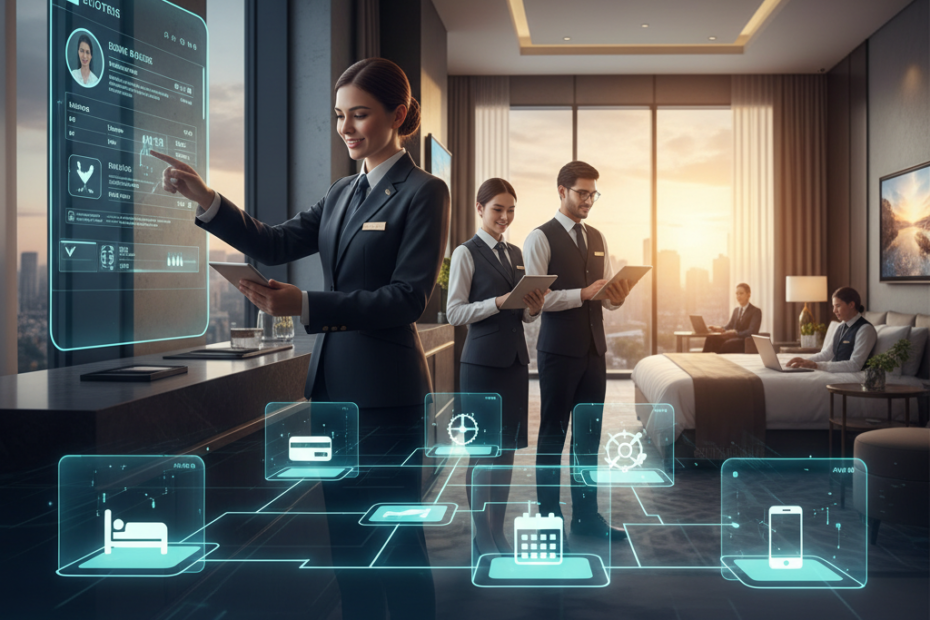
The hotel PMS coordinates guest service details between staff and departments. When the guest makes an online reservation via the hotel’s website, the PMS creates and posts a profile on the system. The reservation is stored in the PMS reservation folio file, and the update on availability is recorded. After the reservation is made the PMS automatically generates a confirmation letter and sends a confirmation email to the guest. The same information is used to update the reservation summary and room availability, and the information is quickly made available to reservation clerks. This spreads to the other departments such as the front office, when the guest arrives on the day of arrival the front office person is able to access the guest reservation by entering their reservation number or their name into the system, and they are able to quickly find the reservation and access the guest profile. The front office’s system automatically finds the guest’s profile and reservation and makes sure that the profile has been updated and the reservation is final. This can then indicate to the front office representative that the room is ready to be rented, upon the arrival of the guest the representative makes sure to verify the guest’s identity by asking for ID and ready the card for the guest to sign when the enter their room for the night. The system can also verify and remember if the guest has settled their bill, checks out, or any room special requests. The front desk system will generate a registration card and quickly prints the registration card before encoding a key card for the guest to use during their stay. The guest is finally able to check in and is quickly assisted because the front office representative has already acquired most of the necessary information and has only to provide the guest with the key and get a signature on the card. The other departments of the hotel along with the various services must all work together and rely on the PMS to keep them functioning together smoothly and without errors.
A guest has checked in and the front desk clerk has verified the guest’s credit, providing their room key and a parking pass. The guest uses the hotel Wi-Fi, and the HSIA gives them access and triggers a fee to be posted to the PMS. They access the fitness center for a workout, and the POS for that department posts the $5 guest charge to the hotel’s PMS folio. After a hot shower using extra towels, the exhausted guest hangs up their wet towels and calls the front desk asking for late checkout. A$ the front office manager allowed this the housekeeping department is advised with an updated report that the room might not need cleaning until the next day.
Real-World Use Cases Across Property Types
The hotel’s front desk uses a daily task calendar to monitor check-ins, check-outs, and housekeeping status. Maintenance-related issues detected via the PMS are automatically dispatched for resolution using an enterprise asset management system. A full-service resort hotel requires a PMS that easily interfaces with point-of-sale systems in restaurants and shops, so guest charges can be automatically added to their final bill. What PMS do you believe each operates with?
The resort scenario requires a property management system that can process all transactions of each guest accurately and quickly in real time. If it doesn’t manage this well, check-outs could be delayed, rooms could be wrongly marked dirty, the restaurant could refuse guests, and bad guest reviews could spread. The technology needs to work behind the scenes to provide a positive guest experience. A PMS whose database can’t keep up with current guest activity or fails to accurately allocate charges simply won’t cut it.
Why a Hotel PMS Matters in 2026
Hospitality has evolved in recent years, and the expectations of today’s customers are very different from what they used to be. Automated mobile check-in, fast check-outs, and real-time chat services , these aren’t a luxury anymore, they’re par for the course. In addition, hotels must manage an increasing number of online distribution channels, each with instantly updated competition rates. All these changes must push the average profit per available room to new limits. As a result, the rise of peer-to-peer review platforms adds an extra layer of urgency to satisfying the customer. A modern PMS is key to: – Providing self-service options to empower guests with the ease of use and access they expect, Automating routines and eliminating errors whenever possible, Enabling staff to engage more deeply with guests, Providing the foundation for revenue management, marketing automation, and operational analytics.
Cloud-based PMS have emerged as the new norm. Lower capital investment, automated updates, and the ease of access typically associated with cloud-based solutions are their key drivers. For the property owner, this means saying goodbye (and good riddance) to the days of endlessly refreshing spreadsheets at the office, performance data is accessible wherever, whenever. For the IT department, it means no more server rooms. For developers, the lifeblood of the PMS, cloud technology allows for endless expansion and accessibility. Most new smart room solutions require a cloud-based PMS. New integrated energy management systems require connectivity to the cloud. New artificial intelligence chatbots require a cloud connection. The list goes on. “Cloud PMS” should almost be considered its own term at this point, such is the importance of this overarching technology to the greater PMS ecosystem.
Choosing the Right PMS for Your Property
When it comes to choosing a PMS solution, there are a lot of options based on size, budget, and operational needs. How do you determine the best one for your property? Are you in the market for a new system but not sure where to start? We’ve seen and used many different PMS solutions over the years and have learned a few things along the way. Whether you’re managing a 20-room luxury boutique hotel, an 80-unit vacation rental property, or a 2,000 room hotel and conference center, identifying your most critical system needs upfront is paramount. Then the devil is in the details in terms of what to look for. Small hotels, B&Bs, and vacation rental properties should consider cloud-based solutions for their cost-effectiveness and user-friendly interfaces. All-in-one solutions that include a built-in channel manager and basic reporting are also a plus for this market as automated processes and reporting capabilities are limited. Enterprise solutions are built with larger hotels in mind and can seem too much for the smaller hotels. However, they bring necessary tools to the table to support hotels of all sizes.