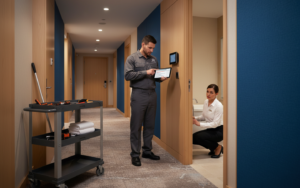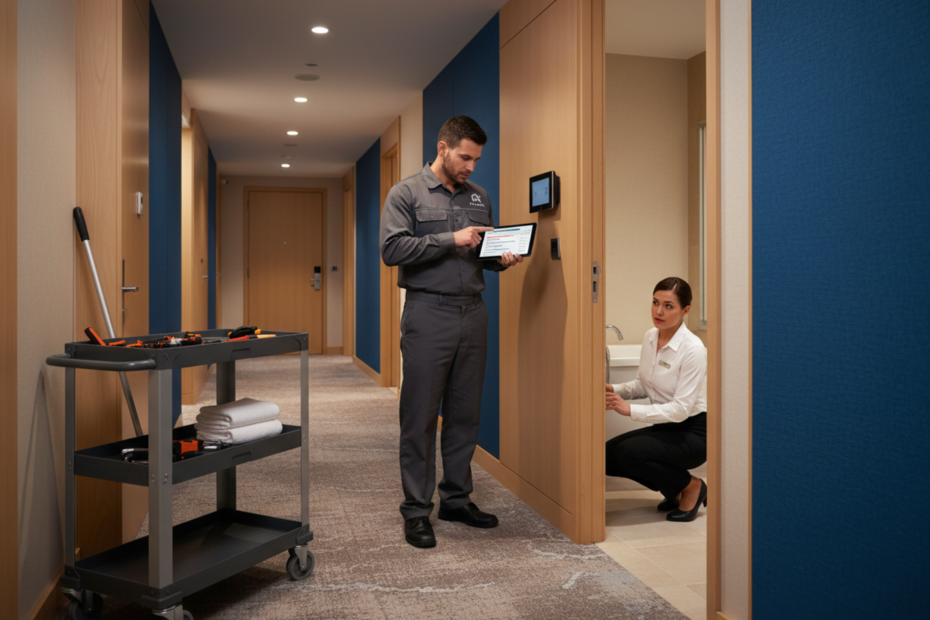
A guest reports a leaking bathroom pipe while another room has a loose wardrobe handle. The maintenance team has limited staff on duty. Both requests need attention, but treating them with equal priority might delay an important repair.
Prioritising urgent versus routine maintenance work orders helps hotel teams allocate technicians, manage room availability and address safety risks. Hotel owners and operations leaders need a clear classification system so employees understand which repairs require immediate attention and which tasks belong on the planned maintenance schedule.
A consistent process also helps managers track response times, assign responsibility and prevent routine defects from becoming larger problems.
Why hotels need a maintenance priority system
Hotels receive maintenance requests from guests, housekeeping, front-desk teams and routine inspections. Requests differ in urgency, cost and operational impact.
Without a defined priority system, teams might:
Delay safety-related repairs.
Assign technicians to minor issues while critical requests remain open.
Lose track of requests during shift changes.
Keep rooms unavailable longer than necessary.
Repeat inspections because repair updates are missing.
Struggle to plan routine maintenance work.
A priority system gives every request a clear response path. It also helps supervisors explain why certain repairs receive attention before others.
Understand urgent and routine maintenance work
The first step is to distinguish between repairs requiring immediate action and tasks suitable for planned scheduling.
Urgent maintenance work orders
Urgent requests involve safety risks, serious service disruption or defects affecting room usability.
Examples include:
Major water leaks or flooding.
Exposed electrical wiring or electrical faults.
Complete air-conditioning failure during conditions where room comfort or safety is affected.
Blocked toilets in rooms with no alternative facility.
Faulty door locks that affect guest security.
Equipment failures affecting essential hotel services.
The hotel should define escalation procedures for each urgent category. Safety-related issues require immediate attention from qualified personnel. Restrict room access when necessary.
Routine maintenance work orders
Routine requests involve defects with limited immediate impact on safety or room use.
Examples include:
Loose furniture handles.
Minor paint damage.
Small cosmetic defects.
Non-essential fixture adjustments.
Preventive equipment checks.
Minor repairs in rooms scheduled for future maintenance.
Routine work should still receive an owner and a completion deadline. Leaving minor defects unresolved often leads to repeated complaints and higher repair costs.
Build a clear maintenance priority classification
Hotels should use simple priority levels. Every employee should understand the difference between each category.
Priority | Type of issue | Required action |
P1: Critical | Immediate safety risk or major service failure | Escalate immediately and restrict affected areas when required |
P2: High | Serious defect affecting room use or guest service | Assign a technician promptly |
P3: Medium | Defect with limited operational impact | Schedule within the agreed maintenance window |
P4: Low | Cosmetic or non-essential repair | Add to the planned maintenance schedule |
Set response and completion targets based on the hotel’s operating conditions, staffing and service commitments. Do not treat these categories as fixed technical or legal standards.
How to prioritise maintenance work orders
A consistent workflow helps supervisors make decisions and keeps repair requests visible.
1. Record every maintenance request
Create a central record for each reported issue. Include:
Request number.
Room number or affected area.
Description of the defect.
Date and time reported.
Name or department reporting the issue.
Photograph, where useful.
Initial priority.
Assigned technician.
Avoid relying only on verbal communication. Written records help teams track requests across shifts.
2. Assess risk and guest impact
The supervisor should consider three factors:
Safety: Does the issue create a risk to guests or employees?
Room usability: Does the defect prevent the room or facility from being used?
Service impact: Does the issue affect essential guest services or hotel operations?
Use these factors to assign the priority. Escalate uncertain safety issues to qualified personnel.
3. Assign the right technician
Match the repair with the technician’s skills and availability. Electrical, plumbing and equipment-related work should go to appropriately qualified employees.
Record the assigned person and expected response time. If the required technician is unavailable, escalate the request to the maintenance supervisor.
4. Coordinate with housekeeping and front desk
Inform housekeeping when a room needs repair before cleaning or inspection. Update the front desk when a defect affects room availability.
After repairs, arrange any required cleaning and inspection before releasing the room.
5. Confirm completion
The technician should record the action taken, parts used and completion time. A supervisor should verify the repair when required.
Close the work order only after the responsible person confirms completion. If the repair remains unresolved, update the status and next action.
Prioritising urgent versus routine maintenance work orders checklist
Use this checklist when reviewing new requests and open work orders.
Every request has a unique record.
Room number or affected area is included.
Defect description is clear.
Safety and guest impact have been assessed.
Priority level has been assigned.
Qualified technician has been selected.
Response target and deadline are recorded.
Housekeeping and front desk receive relevant updates.
Room restrictions are communicated where required.
Repair completion is documented.
Supervisor verification is completed where required.
Open requests are included in shift handovers.
Supervisors should review this checklist during daily maintenance briefings.
Best practices for managing maintenance priorities
Define response targets for each priority
Set internal response targets for critical, high, medium and low-priority work. Make sure targets reflect staffing levels, property size and the hotel’s service requirements.
Measure response time separately from repair completion time. A technician might acknowledge a request quickly but need additional time for parts or specialist support.
Review urgent requests throughout the shift
Do not wait until the end of the day to review critical work. Maintenance supervisors should check open urgent requests and confirm whether teams need additional support.
Keep routine work visible
Routine tasks often remain open because urgent requests receive attention first. Maintain a separate planned-work list with deadlines and assigned technicians.
Review overdue tasks weekly. Reschedule work only after recording the reason.
Identify recurring defects
Track repeated failures by room, equipment type and issue category. Frequent plumbing leaks or air-conditioning complaints might indicate a larger equipment problem.
Review these patterns during maintenance meetings and consider preventive repairs or replacement planning.
Maintain spare-part availability
Identify parts commonly required for repairs. Maintain suitable stock based on equipment requirements and procurement lead times.
Record parts used against each work order. This helps managers understand repair costs and plan future purchases.
Use shift handovers to prevent missed requests
The outgoing supervisor should share open requests, current priorities, assigned technicians and pending actions. The incoming supervisor should review the list before accepting responsibility.
How hotel technology supports maintenance coordination
Accurate room and reservation information helps managers understand which rooms are occupied, vacant or blocked for repairs. A hotel property management system supports reservation and room-availability workflows. Hotels should review how room-status updates fit with their maintenance process.
A hotel front-desk management system also supports arrival planning and reservation coordination. Front-desk staff need current information before assigning rooms to arriving guests.
Aiosell provides connected hotel technology for reservations, front-desk operations and revenue management. Hotels evaluating hotel management software should review how available features support their room information, operational reporting and existing integrations.
Aiosell does not replace a dedicated maintenance work-order system. Hotels should use a suitable register or maintenance platform to record technical requests, assign technicians, track priorities and document repairs. Confirm available integrations before selecting a system.
KPIs to measure maintenance work-order performance
Managers should review maintenance performance through a small set of measurable indicators.
KPI | What to measure |
Response time | Time between request reporting and acknowledgement |
Repair completion time | Time between assignment and completed repair |
Critical request closure | Percentage of critical requests closed within the internal target |
Overdue routine work | Number of routine requests past their deadline |
Repeat repair rate | Requests involving recurring defects |
Room downtime | Time rooms remain unavailable due to maintenance |
Work-order backlog | Total open requests by priority |
Review results weekly and monthly. Compare similar periods and investigate repeated delays. Use findings to adjust staffing, spare-part planning and preventive maintenance schedules.
Conclusion
A clear priority system helps hotel teams respond to critical defects while keeping routine repairs under control. Every request should have a recorded priority, an assigned technician and a defined completion target.
Hotels should review open work orders during shift handovers and monitor recurring problems. Aiosell supports connected reservation, front-desk and revenue workflows, while dedicated maintenance procedures help teams manage repair requests and protect guest-room readiness.
Frequently asked questions
What is the difference between urgent and routine maintenance?
Urgent maintenance involves safety risks, major service disruption or defects affecting room usability. Routine maintenance covers lower-impact repairs suitable for planned scheduling.
Who should assign maintenance priority levels?
The maintenance supervisor or designated operations employee should classify requests using the hotel’s approved priority rules. Employees who report defects should provide accurate details and escalate immediate safety concerns.
How should hotels handle urgent maintenance requests?
Record the issue, assess the risk, restrict affected areas when required and assign qualified personnel. Keep the front desk and relevant departments informed until the repair is complete.
How often should hotels review routine maintenance work orders?
Review open routine requests at least weekly. High-volume properties might need daily reviews to prevent backlogs and missed deadlines.
Which KPIs help hotels measure maintenance performance?
Track response time, repair completion time, overdue tasks, repeat defects, room downtime and open work orders by priority. Review the figures alongside guest complaints and maintenance costs.