Fast, smooth check-in defines a guest’s first impression. In 2026, travelers expect speed, accuracy, and a personal touch on arrival. Yet, many hotels still wrestle with slow processes and manual errors. Optimizing your Hotel PMS Check-In Workflow is not just about technology, it’s about delighting guests and boosting your team’s efficiency. Let’s explore how you can streamline your check-in process, cut wait times, and set a new standard for hospitality in today’s competitive landscape.
Why Check-In Workflow Matters in Modern Hospitality
What will PMS check-in do for your staff and guests in 2025? They’ll meet and greet, no paperwork in sight and it’s all right. A key in the door when your guest walks through. What’s next? It’s all automatic, fantastic, and calm. A menu in hand, might I suggest, all that I need for a perfect stay as your loyal guest. A way extra mile, big smile guarantee, with a quick swipe here on my secure PMS entry.
How can a hotel optimize its guest experience with an efficient workflow at the front desk? We know delays can lead to guest frustration, negative reviews, and loss of business. But what are the causes of these delays, and how can they best be addressed? It’s more than just about improving the guest experience; a well-functioning front desk can help create a great work environment for staff.
The Role of Modern PMS in Streamlining Check-In
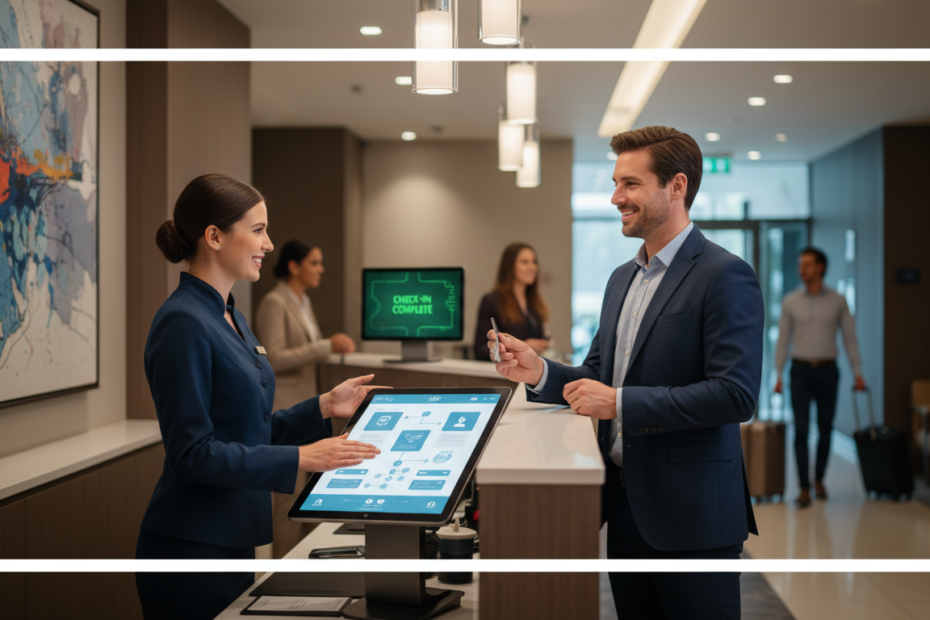
How does it work behind the scenes? Front desk staff access check-ins on a tablet or smart device, and relay the guest’s name to welcoming staff who update their personal details before they reach the counter. The housekeeping is instantly notified upon guest entry so that the rooms can be cleaned up during the allotted check-in time. Wildly efficient!
But how is a modern PMS different from legacy systems? Older property management tools weren’t built to exchange data with all the software applications a hotel uses. So they hold information in silos and can’t automatically sync with other systems or online booking channels. This means staff manually update rates, inventory, and reservations in multiple places. And as reservations climb, so do the chances of human error.
Automated vs. Assisted Check-In
Becoming a hotel of the future isn’t just about technology, of course. It’s still all about people. Superb guest experience relies on well-trained, motivated staff who have time to give personal attention. The latest PMS solutions aren’t about cutting staff numbers; instead, they help managers create more satisfying jobs by removing boring, routine tasks. Joining a global chain or becoming an independent hotel shouldn’t dictate service quality, either. The best PMS gives staff each day the information they need to recognize returning guests and greet them by name, or to know that this is their first visit and offer an upgrade, if that’s what you’ve told the PMS you want to do. Your PMS should make it simple to cater for guests’ wishes, whether they want that upgrade or just want to return to their renovated, favorite room with a view of the park.
Key Steps to Optimize Your PMS Check-In Workflow
The check-in process actually begins long before a guest arrives at your hotel. It starts with an invitation, a promise, a room, a rate, and an experience. An experience the guest expects to be memorable. How it all turns out depends on the performance of your hotel PMS check-in workflow.
Let’s face it, the hotel was not built in a day and neither will it be transformed in a day. But what I can tell you is that mapping the entire workflow right at the beginning sure gives you a head start. Ask your team to elbow down, grab hold of any method available, be it a whiteboard or sticky notes to help map the process. Plot an easy flowchart. List out each touchpoint from reservation to room assignment and from housekeeping to the final payment. What this does is, it gives you a clear picture and where it goes wrong. Are there bottlenecks? Are there too many manual steps involved that can easily be automated? Or are you totally missing out on something that you should have been doing for a while now? Don’t let that happen, we can go back to the history lesson later.
Automate Data Entry. Use PMS integrations to import booking details from OTAs and your website. This means less double entry and fewer mistakes.
Activate Pre-Arrival Checklists: Generate tasks for your team and set up automatically triggered emails for guests requesting additional information or with upcoming bookings.
Update Room Status in Real Time: Is the property management system (PMS) aware in an instant of which rooms have been cleaned, and are now spotless, and we’re good to go? Or does the desk have to make a call, walkie-talkie someone, log into a separate housekeeping module, or worse, send a guest to an unready room with eddying dust devils behind the bedposts?
Teach Your Front Desk Staff How to Use System Shortcuts to Interact and Serve Guests BettergetProperty Management Systems are a great tool to improve efficiency, but the front desk team must know how to make the most of these features. To be able to do so, they should have a good understanding of how to optimize as many system functionalities as possible, including how to access and pull up a guest’s complete profile, notes, and preferences quickly, how to post charges using the appropriate internal codes, how to lookup and apply promotions within a reservation, and how to manage and process check-ins and checkouts seamlessly. Give your front desk team hands-on training. Show staff how to easily and quickly handle and manage these procedures within the Property Management System, and perhaps even issue badges, find printing information and processing payments, or even locate and identify important follow-up tasks in case any unwanted chargebacks appear in the future. The instructor may provide team members with some real-world scenarios and practice activities to help them become more comfortable and familiar with the system. Prepare for some follow-up instructions to ensure that anyone who is unclear about will have a chance to get the additional information they need. By the time the training session is over, your team will have become a lot more comfortable in their use of your property’s system features.
The same five-step method will work for you too, regardless of your industry or the size of your business. For decades, these steps have been transforming businesses. They’ve also been used to improve personal lives and relationships.
Leveraging Aiosell and Other PMS Tools for Maximum Efficiency
How have some hotels across India got so great at automating their upselling and driving more direct bookings? What’s the secret behind the ones that consistently manage to stay on top of their room inventory while hopping across all the key OTAs and doing justice to each one of those room bookings? The answer isn’t something that you didn’t already know… it’s workflow optimization. It’s just that a hotel PMS today can accomplish so much of it for you that you probably didn’t realize the manual or legacy processes you’d been managing. The technological advancements you stand to benefit from include: real-time integrations; automation of a majority of your everyday, routine administrative tasks; easy submission to every OTA you can think of; upselling as an in-built function complete with real-time availability; standalone reporting systems that immediately abandon you with too many reports; and enough free time to think big for the business! It’s vital to understand that each of these features becomes nothing but a long list of cool bullet points if the PMS tool you end up choosing doesn’t necessarily match your workflow, or lack thereof. A PMS, no matter how feature-rich, always remains merely a tool for you to use in finding and implementing those perfect points of automation. Which is why you need it to be the right one.
Aiosell’s dashboard gives managers instant visibility into occupancy, guest arrivals, and pending check-ins. Housekeeping and maintenance teams receive alerts for room readiness. This full-picture view helps teams coordinate, avoid overbooking, and respond quickly to last-minute changes.
What other aspects impact your choice of Airbnb automation? Potential touchless tech options at your property, the existing tech stack (including your PMS’s new features), the property’s size and type, and of course, your guests. How much of the process can and should be mechanized?
Best Practices for a Seamless Check-In Experience
Tap into the power of your PMS: Use configurable room statuses to keep everyone in the loop. A room that’s marked as dirty could mean to housekeeping that the room is ready to go but hasn’t been checked yet by the front desk. A room marked as clean could mean that it’s clean and inspected, but not yet released for check-in. What’s important is that you find a system of room status labels that work and that everyone adheres to it.
Make sure you keep your guest profiles up to date! What preferences and past stay information should you add to a guest profile in your PMS? And how can you leverage this info to personalize welcomes and/or upsell relevant services to your guests?
Give your guests a choice: is it going to be a self-service kiosk in the lobby, your phone in advance, or perhaps a good old-fashioned check-in at the front desk? What’s your pleasure? I’m not sure anyone really knows what the perfect check-in process is. What we do know, however, is that check-in is your guests’ first official experience at your hotel. How often do we hear that first impressions make all the difference? It’s usually the little things that stand out, like the surprise you never saw coming or the exact right word at the perfect moment. That’s why first impressions are make-or-mar. So, the intent of this best practice (not the blueprint, as there probably isn’t one) is to ensure that first experience with you is memorable, enjoyable, and easily becomes part of the overall positive experience. Making check-in a pleasant, timely, and even fun occurrence can set the tone for all other events during your guests’ stay. The flexibility to choose the manner in which your guests check-in may seem a minor detail, but it will go a long way to maximizing their comfort level and overall satisfaction.
Monitor and adjust in real time. Use PMS analytics to track where your bottlenecks tend to form. Is it during the check-in when many guests arrive all at once? If your guests tend to queue up, have your front desk manager monitor the situation and put on another staff member if necessary. Or simply open your digital check-in station.
Review Feedback Regularly: How do you know if your guests are satisfied with the check-in process you provide? Ask them. Asking for feedback can be as simple as sending a post-check-in survey or reading comments on online reviews. Comb through that info regularly and make notes of recurring comments. Strong wi-fi? A welcoming first impression from staff? Use that information to tweak your check-in systems as necessary.
When your team embraces these habits, you create a culture of continuous improvement. Over time, small tweaks add up to major gains in guest happiness and staff morale.
Conclusion
Upgrading is not just about going digital, it’s about taking the opportunity to upgrade the whole thing. Upgrading check-in must include an earnest evaluation of the current experiences you’re providing. Is check-in running smoothly without a hitch, but feeling ‘ok’, ‘nothing special’ or ‘functional’? Or, is it something that you and your team dread due to the consistent queues and bottlenecks that inevitably come hand in hand with manual processes? If it’s the latter check-in experience, it’s time for a change.