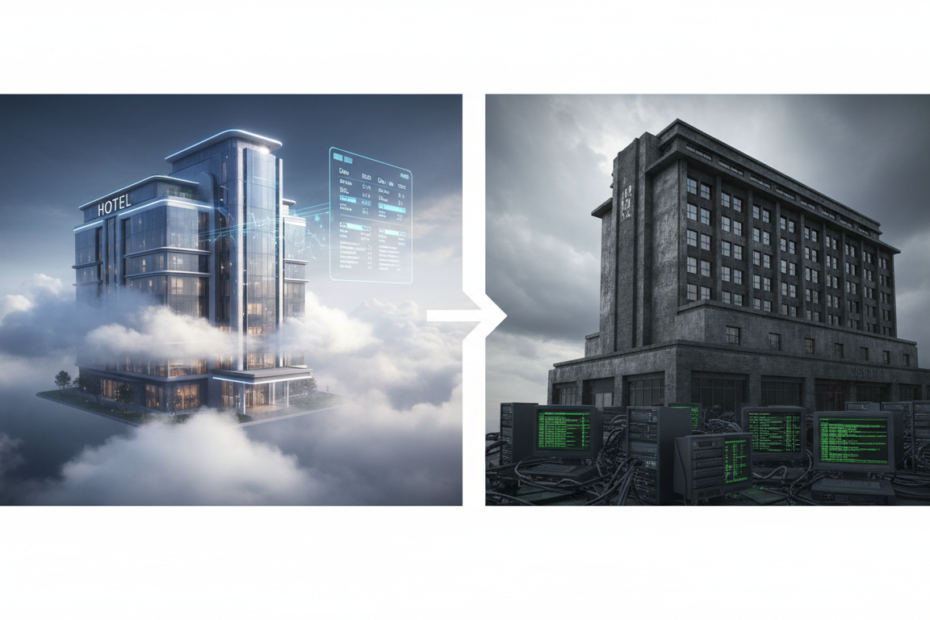
Many hotels still operating legacy property management systems didn’t choose to fall behind — they simply installed a system years ago that worked adequately at the time, and the cost and disruption of switching kept getting deferred. But the gap between cloud hotel PMS platforms and on-premise legacy software has grown wide enough that continuing to defer the decision now carries its own real cost, in lost efficiency, distribution errors, and missed revenue opportunities.
This guide compares the two approaches directly and lays out a practical path for hotels considering the move.
What Separates Cloud From Legacy
A legacy property management system typically runs on a physical server installed on-site, requiring the hotel to manage its own backups, security patches, and hardware maintenance. Access is often restricted to terminals physically connected to that server, which limits flexibility for staff who need to check availability or update records away from the front desk.
A cloud hotel PMS, by contrast, runs on infrastructure maintained by the software vendor and is accessed through a browser or mobile app from any internet-connected device. Updates deploy automatically, without requiring a technician on-site or scheduled downtime. Data backups happen centrally, removing the risk of a single hardware failure wiping out reservation records.
The practical difference shows up daily. A general manager checking occupancy from home, a housekeeping supervisor updating room status from a tablet, or an owner monitoring performance across a multi-property portfolio from a phone — none of these are realistically possible on a rigid, on-premise legacy system.
Where Legacy Systems Still Fall Short
Beyond accessibility, legacy systems tend to struggle in a few specific areas that matter increasingly in a distribution landscape with a dozen or more active OTA channels:
Integration limitations. Older platforms were often built before modern API standards existed, making it difficult or impossible to connect cleanly with a channel manager, online booking engine, or revenue management tool. Hotels running legacy PMS often resort to manual rate updates across channels — a process that’s slow and prone to human error.
Update cadence. Feature improvements and security patches on legacy systems typically arrive infrequently, sometimes requiring a paid upgrade cycle. Cloud systems push updates continuously, meaning hotels benefit from ongoing improvements without a separate purchasing decision.
Scalability friction. Adding a new property to a legacy system setup often means installing and configuring an entirely separate instance. Cloud-based, multi-property architecture handles this far more smoothly, letting groups manage several hotels from a single account structure.
Total operational burden. Legacy systems often require dedicated IT support, whether in-house staff or an external contractor, to maintain uptime and troubleshoot hardware issues — an ongoing cost that cloud infrastructure largely eliminates.
Why Hotels Delay the Switch
The most common reason hotels stay on legacy software longer than they should is fear of disruption. Migrating guest records, historical booking data, and rate configurations feels risky, particularly for a property that can’t afford downtime during a busy season. That concern is legitimate, but it’s also manageable with proper planning, and it shouldn’t be the deciding factor against a move that improves daily operations for years afterward.
Some hotels also assume their current system, however outdated, is “good enough” because staff have adapted to its quirks over time. This is often a sunk-cost pattern — the hours spent working around a system’s limitations rarely get counted as a real cost, even though they add up significantly across a year.
Planning a Low-Disruption Migration
Choose a migration window carefully. Shoulder season, when occupancy is lower, minimizes the operational risk of running parallel systems briefly or training staff during the transition.
Insist on a clear data migration plan. Reputable property management system vendors have established processes for transferring guest profiles, historical reservations, and rate plans without data loss. Ask specifically how this process works and request a timeline before committing.
Run a parallel period if possible. Keeping the legacy system accessible in read-only mode for a short overlap period gives staff a safety net while they adjust to the new interface.
Prioritize staff training before go-live, not after. Front desk teams under pressure during a busy check-in period shouldn’t be learning a new system simultaneously. Structured training in the days before launch reduces early errors significantly.
Connect distribution channels early. Before going fully live, verify that the channel manager, booking engine, and OTA connections are correctly configured and tested, so rates and inventory sync properly from day one.
The Business Case Beyond Convenience
The advantages of cloud hotel PMS extend well past convenience. Real-time synchronization with a channel manager reduces overbookings and rate discrepancies across OTAs. Built-in or connected revenue management tools allow dynamic pricing based on demand, something legacy systems generally can’t support without a separate, poorly integrated add-on. Mobile accessibility means management decisions can happen faster, based on live data rather than end-of-day reports.
For groups and chains, the consolidation of multiple properties under one cloud account also simplifies reporting and reduces the administrative burden of managing separate systems location by location.
Making the Decision
Migrating away from a legacy property management system is rarely comfortable in the moment, but the hotels that delay it longest tend to accumulate the largest gap between their operations and what modern cloud infrastructure can deliver. With a structured plan — the right timing, a clear data migration process, and proper staff preparation — the transition can happen with minimal disruption to guests or daily operations.
The question worth asking isn’t whether your current system still technically functions. It’s whether it’s actively limiting how efficiently your property could be running, and how much longer that limitation is worth accepting.