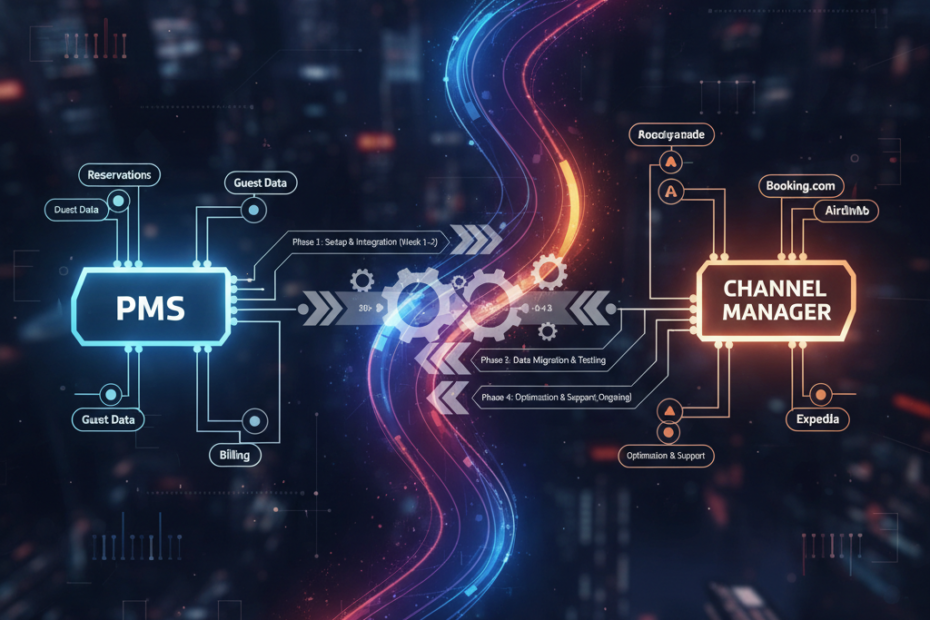
I’m here to tell you that many hoteliers grossly underestimate the complexity of integrating a property management system with a channel manager. The resulting disruption to day-to-day business, not to mention aggravated staff members, who knew if you’re better off with the manual process you currently have to deal with, hit revenue. The good news is it’s not hard to avoid these disruptions, expenses, and delays. And you don’t have to grope around in the dark trying to find your reality path. The first steps are pretty straightforward. You just need to understand how long your journey is going to take and decide if you can handle the multi-tasking that’s necessary.
Understanding the PMS Implementation Timeline
A usual PMS implementation timeline covers 8 to 16 weeks. However, how long this will actually take depends on the size of your hotel and the complexity of your systems. Smaller boutique hotels with less than 50 rooms frequently finish the process in just two months, whereas a larger property or chain could require at least four. Whatever your size, rushing this process will simply lead to more problems, and greater associated cost, than taking a steady pace.
The second phase, implementation, is more straightforward but can last from one to six months depending on the platform’s complexity and how many changes you’ve requested. Your team will have completed the initial training and testing so they feel comfortable with the system and ready to train other users. This is where the rubber meets the road. Your vendor should be available on-site to minimize disruptions and answer questions as you go live. Most likely, other departments will see the benefits of your system and begin to express interest in how it can help them.
Channel Manager Integration: The Critical Connection
Would it not be wonderful if everything was instantly synced across all your systems and channels? A guest books a room on a travel site and the room is automatically marked as sold out in your PMS as well as on the site of all your other connected OTAs. This prevents overbooking while also creating an automated, real-time update of rates and availability. A guest checks-in after a long flight and heads up to their meticulously prepared room within minutes of arriving. Data is sent directly to the PMS so they can simply sign and initialize their details that were pre-populated at booking. No manual paperwork. No annoying, time-consuming manual data entry. Just send the guest keying straight through to the payment portal and allow them to get their vacation started ASAP.
How does a Property Management System connect to all the channels where you list your rooms? These systems operate on a set of APIs unique to each channel or booking source. Most modern PMS platforms now offer native connections to all major channels. Still, sometimes you may use a specialized tour or regional booking system. In that case, your partner will need to create a new API module to link that booking source. It isn’t necessarily difficult work, but you can add a month or two to the work plan.
Data Migration and System Configuration
This is where easy-to-use data migration tools and tech support really pay off. The more seamless the transfer of your existing guest, transaction, and inventory data, the quicker you can start entering new reservations with confidence. Such tools usually include preformatted templates and help convert and import guest lists, apply credits and reservations to books, and reload rate, agency, and source data. It’s also essential that all data mapping and conversion rules are clearly documented.
How do you extract transferable meaning from all that jargon? Think of it this way: Before plugging in your new software, what do you want it to look like and do? Who should access what info? Your front desk needs different access levels than housekeeping, and your revenue manager needs reporting tools that your maintenance staff doesn’t. Nailing all of this down on the front end requires a liaison or a mediator. Run into any issues? Reconfigurations can gobble up any extra time you thought you had.
Staff Training and Change Management
What’s the point of purchasing cutting-edge software if employees resist taking full advantage of its game-changing features? Training is essential for a successful software adoption but how much is enough? It’s hard to tell, but I’m not sure anyone really knows, probably because every software is different… and so are the people who will use it. One fact remains: the more familiar employees are with the software, the better equipped they’ll be to perform their daily tasks efficiently.
Training is not a one-and-done event. Your property management software is constantly evolving, with new features and daily use teaching your team shortcuts to improve their efficiency. Giving your staff access to vendor training and encouraging ongoing learning through modules in the software helps keep your property’s competitive advantage intact and supports staff retention. Standard community management software may seem utilitarian when you first implement it, but as your team becomes more fluent in its use, the benefits continue to grow.
Testing, Go-Live, and Post-Implementation Support
A parallel run is a practice that can be very effective for hoteliers, and it is so common, we highly recommend it if you have the time. It is a 1 to 2 week period where you use both your old and new PMS (Property Management System). It can be extremely beneficial to get the bugs out in a real-time exercise before your new PMS system goes live. It can catch a problem before it gets amplified and literally passes the headache on to your guest. A dual environment can also get your staff used to working in the new system so it’s not a big shock when you do go live.
You’ll be heavily reliant on your interface/EDI programmer, at least for the first few months. Insist on-site availability in addition to immediate response, especially if they’re contracted for support in this phase. Remember Murphy’s Law, so confirm that escalation procedures cover you and your vendors. Whether it’s the fiscal service promising 837s sent correctly or the reference lab swearing they match their patients to samples, you can’t do it alone. Pick clean-up, conversion work, and how-to questions are prime for overflow.
Optimizing Your Workflow Post-Implementation
The rubber meets the road after the system launch. That’s when you get down to the real business of fine-tuning operations based on how the tools are actually being used. For instance, you may have automated routines that seemed great on paper but just aren’t used in practice. Or you have employees developing workarounds that signal a workflow or process problem. Your PMS and channel manager should be solving problems and reducing work, not creating new administrative loads. A 30-day check-in should include everyone involved in the process, front desk, housekeeping, maintenance, and management. The quarterly review should focus on automations that replace formerly manual tasks, and that the report details and integrations are providing the exact info needed without too much unnecessary information.
The most effective tools to manage your properties are the ones your team will actually use, and use correctly. That’s the real “secret sauce” in hospitality operations , not the tools themselves, but the right people successfully applying them in the real world. Find those tools, give those people the training and the freedom to make the most of them, and you’re on the surest path to improving your business.