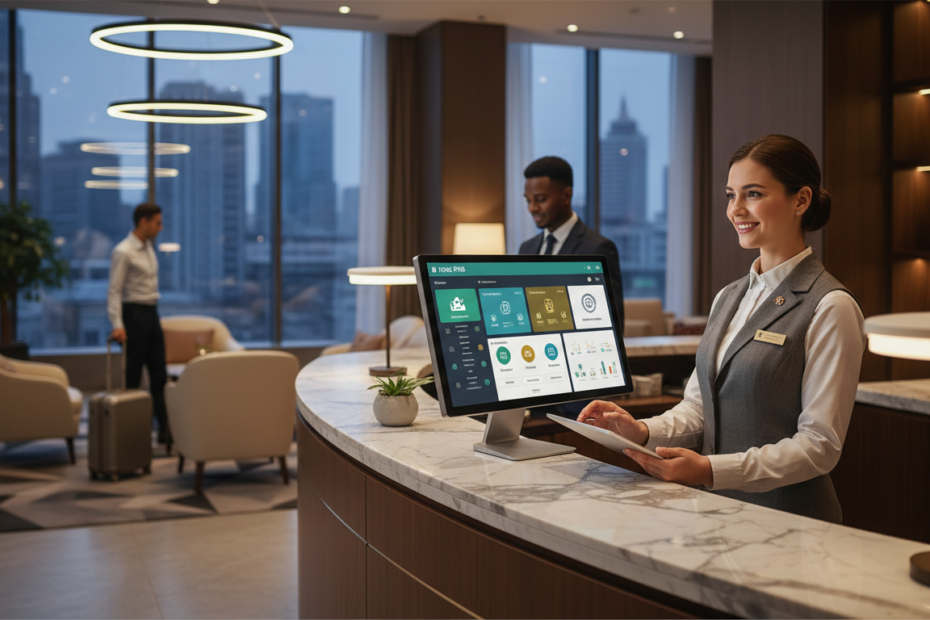
The front desk is where a property management system earns its keep or reveals its weaknesses most visibly. Every guest interaction, from the moment a reservation is confirmed to the final folio review at departure, runs through this workflow, and small inefficiencies here compound quickly during busy periods. Optimizing this process isn’t about adding more steps for staff to follow — it’s usually about removing the friction that slows down otherwise straightforward tasks.
Pre-Arrival: Setting Up a Smooth Check-In
The check-in experience actually begins before a guest arrives. A well-configured property management system allows pre-arrival information — ID verification, payment details, special requests — to be collected in advance, whether through an online pre-check-in form or automated communication sent a day or two before arrival. This reduces the amount of information staff need to gather at the desk itself, shortening the actual check-in interaction considerably.
Room assignment can also happen ahead of time for many bookings, particularly for guests with specific preferences already on file. When the PMS pulls guest history and preferences automatically, staff aren’t starting from scratch with every arrival, and returning guests notice when a hotel remembers details from a previous stay without needing to ask again.
The Check-In Moment
At the desk itself, workflow efficiency depends heavily on how quickly staff can locate a reservation, verify identity, confirm payment, and issue room access. A cluttered or slow reservation search function turns a simple task into a frustrating delay, particularly during group arrivals or peak check-in hours when a queue starts to form.
Systems that support digital registration, integrated ID scanning, and automated key encoding directly from the check-in screen reduce the number of separate steps staff need to complete manually. For hotels handling significant walk-in traffic, a streamlined process for creating a new reservation on the spot, without navigating through screens designed primarily for pre-existing bookings, also matters considerably.
Managing Group Check-Ins
Group arrivals test front desk workflow more than almost any other scenario. A property management system with strong group handling allows staff to check in an entire group efficiently, working from a pre-loaded rooming list rather than processing each guest individually as a separate, unrelated transaction. Batch key encoding and simplified group folio management reduce what could otherwise be a lengthy, error-prone process into something manageable even during high-volume arrival windows.
Mid-Stay Efficiency
Front desk workflow doesn’t end after check-in. Throughout a guest’s stay, staff frequently handle room changes, service requests, and charges that need posting to the correct folio. A well-integrated system connects front desk operations with point of sale charges from restaurants or the spa, and with housekeeping status updates, so staff always have an accurate, current view of a guest’s account and room status without needing to check multiple separate systems.
Real-time housekeeping integration matters particularly here — when a room’s status updates the moment it’s cleaned and inspected, front desk staff can respond to early check-in requests or room change requests immediately, rather than waiting on a manual confirmation from housekeeping.
Streamlining Check-Out
Check-out workflow efficiency affects both guest satisfaction and staff time, particularly during peak departure hours when many guests want to leave around the same time each morning. A clear, accurate folio review — with all charges from rooms, dining, and other outlets already consolidated automatically — prevents the common friction point of disputed charges discovered only at the final bill review.
Express check-out options, where guests can review and settle their folio without a full desk interaction, reduce congestion during busy mornings and give guests who are simply in a hurry a faster path to departure. This works best when the PMS has been accurately tracking all charges throughout the stay, so nothing surfaces unexpectedly at the final review.
Reducing Errors Through Better Workflow Design
Many front desk errors trace back to workflow gaps rather than staff carelessness — a charge that didn’t post automatically and gets missed at checkout, a room status that wasn’t updated in real time leading to a guest being assigned a room still being cleaned, or a reservation detail that wasn’t visible clearly enough during a rushed check-in. Evaluating your current front desk workflow with this lens — looking for where the system requires manual cross-checking rather than surfacing information automatically — often reveals specific, fixable friction points.
The Role of Mobile Access
Increasingly, front desk workflow isn’t confined to a fixed terminal. Staff using tablets can greet arriving guests in the lobby rather than requiring everyone to queue at a desk, particularly useful during group arrivals or high-occupancy periods. Mobile access extends this flexibility to housekeeping and maintenance staff as well, keeping room status and service requests updated in real time regardless of where staff are physically working within the property.
Measuring Workflow Performance
Tracking metrics like average check-in time, check-out time, and walk-in conversion rate gives management concrete data on whether front desk workflow is actually performing well, rather than relying on general impressions. Reviewing these metrics periodically, alongside direct staff feedback about where they encounter friction in daily tasks, helps identify specific configuration changes or training needs that improve the process incrementally over time.
Building an Efficient Front Desk Foundation
The strongest front desk workflows share a common trait: they minimize the number of separate systems or manual steps staff need to navigate for routine tasks. A property management system that consolidates reservations, guest profiles, housekeeping status, and billing into one connected interface gives front desk teams the tools to handle both routine check-ins and higher-pressure situations like group arrivals smoothly, ultimately shaping the guest’s first and last impressions of the property.