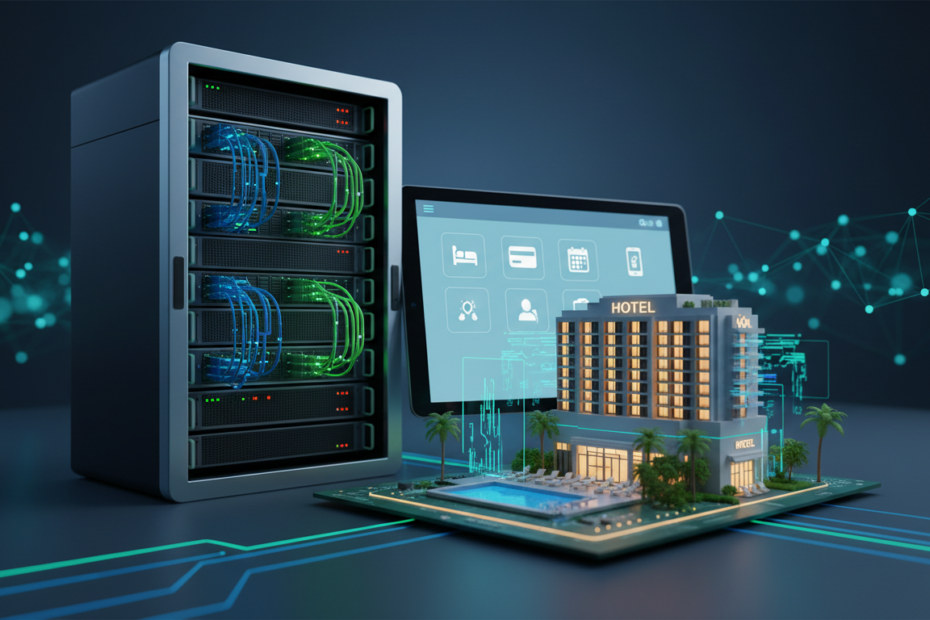
Every hotel, regardless of size or star rating, runs on a central piece of software that coordinates reservations, guest records, room status, and billing. That software is the hotel PMS — short for property management system — and the choices a hotel makes around it shape almost every other part of operations, from how quickly guests check in to how accurately rooms show up on booking sites.
Heading into 2026, the gap between hotels running modern, connected systems and those still relying on outdated, disconnected software has widened considerably. Guest expectations have shifted toward speed and personalization, distribution has grown more complex with a dozen or more online channels to manage, and staff shortages mean every property needs software that reduces manual work rather than adding to it. This guide walks through what a hotel PMS actually does, how it fits into the broader technology stack, and what hoteliers should weigh before choosing one.
What a Hotel PMS Actually Does
At its core, a property management system handles the daily mechanics of running a hotel: managing reservations, assigning rooms, processing check-in and check-out, generating folios and invoices, and tracking room status for housekeeping. It’s the system your front desk team touches constantly, which means usability matters as much as feature depth.
Beyond these front-desk basics, a capable property management system also maintains guest profiles and stay history, supports group and corporate bookings, and gives management a live view of occupancy and rates across the property. In multi-property operations, a good hotel PMS extends that visibility across every location from a single dashboard.
Why PMS Software Has Become More Central, Not Less
A decade ago, many hotels treated their property management system as a standalone booking ledger, with separate tools handling distribution, pricing, and guest communication. That approach creates friction. Rates update in one system but not another. A booking confirmed on an OTA doesn’t reflect in the front desk calendar until someone manually types it in. Errors compound, and so does the risk of overbookings.
Modern hotel PMS systems are built to sit at the center of the technology stack, connecting directly with a channel manager for real-time rate and inventory distribution, a booking engine for direct reservations, and a revenue management system for pricing decisions. When these pieces share data automatically, front desk staff spend less time reconciling information and more time attending to guests.
Cloud-Based vs On-Premise: The Shift That Already Happened
Legacy hotel software required a server on-site, IT staff to maintain it, and manual backups to avoid catastrophic data loss. Cloud-based systems removed nearly all of that overhead. Updates roll out automatically, data is backed up centrally, and staff can access the system from any device with a browser — useful for a general manager checking occupancy from home or a housekeeping supervisor updating room status from a tablet.
This shift matters for hotels of every size, but it’s been particularly significant for independent properties and small groups that never had the budget for a dedicated IT function. A cloud PMS gives them the same operational reliability that large chains built internally, without the associated cost of maintaining it.
Core Modules to Evaluate
When comparing hotel PMS systems, a few categories consistently separate strong platforms from weaker ones:
Front desk and reservations — the speed and clarity of the booking calendar, ease of modifying reservations, and how well the system handles overbooking scenarios and room assignment logic.
Housekeeping and maintenance coordination — whether room status updates flow both ways between front desk and housekeeping staff in real time, which directly affects how quickly rooms become sellable again.
Reporting and analytics — the ability to pull occupancy, ADR, RevPAR, and other performance metrics without needing a separate business intelligence tool.
Integration depth — how easily the PMS connects to a channel manager, payment gateway, point of sale, and other operational software rather than functioning as an isolated silo.
Multi-property support — relevant for groups and chains that need centralized reporting and configuration across several locations rather than logging into separate accounts for each property.
Choosing the Right Fit for Your Property
There’s no single “best” hotel PMS — the right choice depends heavily on property type, size, and the complexity of operations. A boutique property with fifteen rooms has very different requirements than a 200-room resort running multiple restaurants and a spa. Independent hotels often benefit most from an all-in-one hotel management software approach, where PMS, distribution, and revenue tools come bundled together and share data natively, reducing both setup time and the ongoing burden of managing separate vendor relationships.
Groups and chains, meanwhile, tend to prioritize centralized control — the ability to configure rate strategies, review performance, and manage staff access across every property from one login, rather than treating each hotel as a separate technology decision.
Implementation time is another practical factor. Systems designed for quick onboarding can typically go live within a week, while legacy platforms sometimes take months of configuration before a hotel can fully operate on them.
Looking Ahead
The property management system category is evolving quickly. Artificial intelligence is increasingly built into forecasting and pricing decisions rather than treated as an add-on. Mobile access is becoming standard rather than optional, letting staff manage tasks away from a fixed front desk terminal. And the expectation that a PMS connects seamlessly with channel managers, booking engines, and point-of-sale systems has moved from a competitive advantage to a baseline requirement.
For hoteliers evaluating their technology stack in 2026, the underlying question isn’t just “what can this PMS do” but “how well does it work with everything else running the property.” A hotel PMS that operates in isolation, however feature-rich, ultimately creates more manual work than it saves. The properties seeing the strongest operational and revenue gains are the ones treating their property management system as the connective layer for the entire business — not just the front desk.